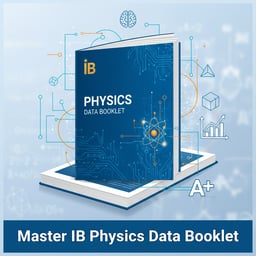
Mastering the IB Physics Data Booklet: Your Insider's Guide
The IB Physics Data Booklet is one of the most powerful tools you have in the exam hall. But let's be honest, most students just see it as a list of equations to use when they're stuck. We're here to change that. At Lanterna, we've seen how top students use this booklet not as a last resort, but as a strategic asset that boosts their speed, accuracy, and overall grade.
This guide will show you how to turn your Data Booklet from a simple reference sheet into a dynamic tool that helps you think like a physicist.
By the end of this guide, you'll know how to:
- Annotate your personal copy to deepen your understanding (for revision, of course!).
- Understand the hidden conditions and common traps behind the formulas.
- Use constants and conversions to solve problems faster and more accurately.
- Spot the "hidden" links between topics that the IB loves to test.
- Navigate the booklet efficiently under exam pressure.
More Than Just a Formula Sheet: Your Ultimate Ally
The IB doesn't just give you the Data Booklet for the exam; they expect you to use it from day one of the course. That's a huge hint! Mastering its layout is a skill in itself. The booklet (for exams from 2025 onwards) is split into two key parts:
- Section 1: Universal constants, mathematical formulas, circuit symbols, and other data you'll need across all topics.
- Section 2: Equations organised by syllabus topic, from "Space, time and motion" to "Fields".
Knowing this structure means you can flip straight to the right page for a mechanics problem instead of wasting precious minutes searching.
The Art of Annotation: Making the Data Booklet *Yours*
Crucial Reminder: Your annotated Data Booklet is a study tool only. In the exam, you'll get a clean, unmarked copy. The goal here is to build deep knowledge during your revision so that using the clean copy becomes second nature.
Here’s how our top-scoring graduates recommend you mark up your personal copy for revision:
- Add Diagrams & Visual Cues: Physics is visual. Next to the formula for the inverse square law, sketch how field strength drops off with distance. Next to Ohm's law, draw the I-V graphs for a resistor, a lamp, and a thermistor. A quick sketch can trigger your memory far better than the formula alone.
- Clarify Variables and Units: Don't assume you'll remember what every symbol means under pressure. Next to W = Fd cosθ, write down that 'θ' is the angle *between* the force and displacement. Specify the required units (e.g., "metres, not cm!") to avoid silly mistakes.
- Sketch Key Graphs: Many marks come from interpreting graphs. Next to the impulse formula, sketch a force-time graph and write "Area = Impulse (Δp)". Next to the work-done formula, sketch a force-distance graph and note "Area = Work Done".
- Note Interconnections: Physics topics are all linked. Draw lines connecting related formulas. For example, link the kinetic energy formula (½mv²) with the momentum formula (p=mv) and add the powerful derived relationship that's often missed: p² = 2mEₖ. This is a lifesaver for questions that link momentum and energy.
Decoding the Formulas: Beyond Surface-Level Understanding
Just finding the right formula isn't enough. You have to know its rules and limitations.
Context is King
Always ask, "When does this formula actually work?" The classic example is the 'suvat' equations (kinematic equations). They are your best friend for projectile motion, but only if acceleration is constant. If you use them for a situation with changing acceleration, you're guaranteed to get the answer wrong.
Common Misconceptions & Traps
- Impulse (J = FΔt): The 'F' in this equation is the average force, not the peak force. Remember that impulse is also the change in momentum (J = Δp), which is often the easier way to solve a problem.
- Work Done (W = Fd cosθ): That 'θ' is critical. It's the angle between the direction of the force and the direction of the displacement. If they are perpendicular, cos(90°) = 0, and no work is done, no matter how big the force is!
- Moment of Inertia (I): The Data Booklet gives you I=mr² for a point mass. For more complex shapes (like spheres or rods), the IB will either give you the specific formula for 'I' in the question or expect you to deal with a system of point masses. Don't panic about memorizing them.
Constants & Conversions: Your Shortcut to Accuracy
That first page of "Fundamental Constants" is pure gold. Using it effectively can seriously speed you up, especially in Paper 1.
- Know the Key Players: You don't need to memorize them all, but being familiar with the approximate values for g (9.81), c (3.00 x 10⁸), and the charge of an electron will save you time looking them up. The conversion from electronvolts (eV) to Joules (J) is another one you'll use constantly.
- Don't Mix Up Your G's: Be crystal clear on the difference between 'G' (the universal gravitational constant, 6.67 × 10⁻¹¹) and 'g' (the acceleration of free fall on Earth, ~9.81). They are not the same!
- Master Unit Prefixes: A huge number of marks are lost to simple conversion errors. Know your metric prefixes from pico (10⁻¹²) to tera (10¹²). Before you plug any number into a formula, double-check that it's in standard SI units (metres, kilograms, seconds, amperes, etc.).
Exam Day Playbook: Staying Cool Under Pressure
You've done the prep, now it's time to execute. Here’s how to use the clean booklet on exam day:
- Use Your Reading Time: Take 30 seconds of the reading time to just open the Data Booklet. Remind your brain where the main sections are. This quick mental map will stop you from panicking later.
- Map Question to Topic: When you read a question, first identify the topic (e.g., "This is a thermal physics question"). Then, turn directly to that section in the booklet. This is so much faster than scanning the whole thing.
- List Your Variables First: Before you even look for a formula, read the question and write down all the variables you've been given (e.g., m = 2.0 kg, v = 5.0 m/s, t = 10 s). Now, go to the right section and find the formula that connects them. This systematic approach prevents careless errors.
- Estimate for Paper 1: In multiple-choice questions, use the constants to make a quick "order of magnitude" estimate. If your calculation gives you an answer of 10³, but the options are all around 10⁻³, you know you've made a mistake somewhere. This is a fantastic way to catch errors.
-1.png?width=150&height=56&name=logotype_lanterna_education_blue%20(4)-1.png)