-1.png?width=150&height=56&name=logotype_lanterna_education_blue%20(4)-1.png)

Ah, yes, IB’s infamous Science Internal Assessments (IAs). Either you love the Science IAs, or you hate them. Regardless of your feelings about them, you must write them, and since they usually make up around 20% of your mark, they are worth doing well.
In this post, I will gather tips and tricks for the Research Question, Personal Engagement, and Communication. I’ve collected the advice you’ll read below from my tutoring experience, our Science IA Guide, and fellow tutors to help you get that magical 7.
To clarify: when I write “Science IAs”, I mean the internal assessments for Physics, Chemistry, and or Biology (SL and HL). Most of the tips will also apply to other subjects, but I’ve designed them with those three subjects in mind. Read this post if you want solid Math AA/AI IA (SL or HL) advice.
As summer break approaches, also known as writing break, it is an ideal time to complete the IAs. But before we dive into that, I would like to address a question frequently asked by students – “What is the point of writing Science IAs?”
Why We Write Science IAs
The IB Sciences have a reputation for being challenging courses. Adding an IA to write on top of the mountains of information you have to learn might seem cruel. But, as our Science IA Guide points out, the IA is not just an evil ploy designed to torture students; there’s a method to the madness!
The lab skills you demonstrate in the IA combine with the theoretical knowledge you learn for the exams to make you a well-balanced scientist (if you are preparing for IB Science exams, check out this post). Or, as our Guide puts it:
“Experimental science drives progress and discovery. So, teaching science without experimentation is like trying to bake a cake with no flour.”
And yes, baking a cake without flour is technically possible, but we all know that gluten-free cakes are inferior.
Now that we covered the why of writing science IAs, let’s look at the how! Apply the following tips if your goal is a 7 or you just want to do well. We’ll start with the research question!
Getting the Research Question Right for Your Science IAs
The first thing you need to get right is what question you will seek to answer with your investigation. This will be the research question (RQ), and it will shape your entire Science IA.
To help you find the right research question, I will walk you through 3 key things to remember, taking some inspiration from this post on finding the perfect EE research question.
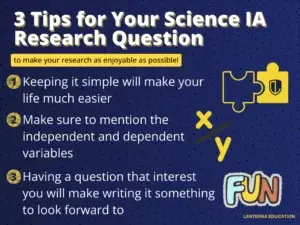
Research Question Tip 1: Make it Simple
The urge to solve huge problems often temps students trying to develop an RQ. Don’t fall for the trap! Keeping it short and sweet for all IAs (and even the EE) is an absolute must! Doing so ensures you can stay within the (current) 6-12 page limits.
The goal is not to make groundbreaking discoveries. You simply aim to show your mastery of lab work so that you can present your findings logically.
In the spirit of keeping your science IA uncomplicated, I recommend you investigate something already done before. You can add your own spin to it, of course, as long as you ensure you clearly communicate what you did. I will cover some communication tips later in this post.
If you are working on a Physics IA (SL or HL), for example, you could investigate the effect of temperature change on the refractive index of a solution. It’s a straightforward premise that could easily land you a 7 if you do it well. This post has some more great Physics IA ideas for you.
Don’t try to reinvent the wheel in your Internal Assessment!
Research Question Tip 2: Mention the Variables
Your research questions should clearly state the independent variable (the IV, what you change) and the dependent variable (the DV, what you observe a change in). In the previous Physics IA example, the IV is the temperature, and the DV is the solution’s refractive index. A helpful template you can use when coming up with a question is:
To what extent is the DV dependent on the IV?
The RQ is what you will seek to answer with your report, and your conclusion will be where you give your best guess.
Research Question Tip 3: Make it Interesting
Making the RQ about something you are curious about is the best thing you can do for yourself. It will make the entire science IA writing process much easier, so I mention it despite it seeming painfully obvious. Look at your hobbies and see if any principles you have learned in your classes apply.
If you, for example, love to cook, you could use your titration skills from Chemistry (SL or HL) to evaluate the effect of temperature on nitric acid concentrations in lemons, which impacts taste. I’ve written about more Chemistry IA (SL and HL) ideas in this article.
Pro Tip: If you’re struggling to come up with a research question, try using this trick Jay Ayliffe outlined in his post on the History IA (SL and HL): don’t look for the perfect RQ; instead, scroll through the criteria they have set in the mark scheme. You can also check out this post on what to do if you’re stuck finding Science IA ideas.
Once you’ve chosen a topic that excites you, you’ll set yourself up to get full marks in the personal engagement criterion, which we will discuss now!
How to Show Personal Engagement
The IB grades the Science IAs out of 24 marks, 2 of which you gain if you show sufficient “personal engagement.” I see many students misunderstand this concept, which leads to an avoidable loss of marks. Here’s what to keep in mind to prevent unnecessary mishaps in this department:
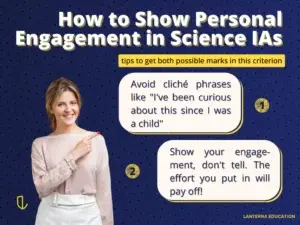
Don’t be Cliché in Your Science IA
You want to avoid cliché phrases like “I’ve been interested in the citric acid content of lemons since I was a child,” since any examiner (in the case of your IA, your teacher) will see right through this. While it is true that you are to “demonstrate personal significance, interest or curiosity,” it comes across as cheesy or dishonest if you do it so directly.
Instead, try a more indirect approach, where you make your interests in the topic clear by talking about your RQ’s implications on the real world, and use that as your justification for choosing this angle.
Show That You Are Engaged, Don’t Tell
You might have heard the phrase “Show, don’t tell” from English Language and Literature (SL or HL) class, but it’s also a good tip for writing scientific reports. Talk about interdisciplinary skills!
Showing your creativity is an excellent way of letting examiners see your Personal Engagement. Being creative might sound like it contradicts the previous advice of sticking to something already done, but it doesn’t have to! Maybe you exemplify your Engagement by the effort you put into setting up the experiment and the creative ways you come up with to limit uncontrolled variables.
Another fantastic method of achieving those Personal Engagement marks is by putting effort into the looks of your IA. Gorgeous layouting goes hand-in-hand with the communication criterion, so let’s talk about that now.
3 Quick Tips for Clear Communication in Your Science IAs
Students often think that they just have to write well to get the marks for communication. While that is crucial, there is so much more to it. You should do these three things to ensure you get all out of the possible four marks for this criterion:
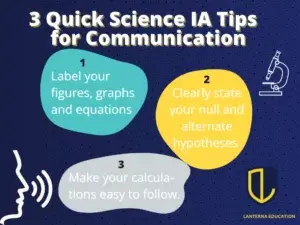
- Label your figures, tables, and equations.
Almost every IB student labels Science IA figures and tables, but only some will number their equations. Labelling your equations is not always necessary (especially not if you’re writing a Biology IA (SL or HL)), but it can significantly help the reader if you refer to them later in the text.
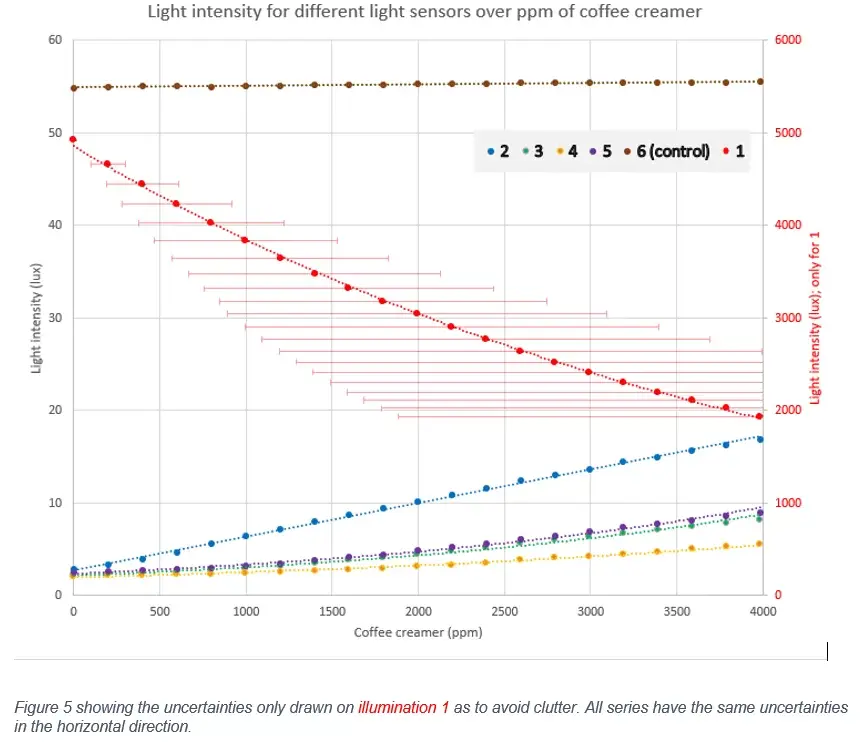
You also want to ensure that every graph you include has clearly labelled x- and y-axes, and it must show the equation of any best-fit line. In the caption, you should state what the figure shows. Here’s an example of what a good Science IA graph should look like (note, there are no equations given for best-fit lines, as they aren’t relevant for this paper).
- Clearly state a null and an alternate hypothesis.
It will be easier for the person reading your IA to follow if you dedicate a section to your hypothesis. The null hypothesis H0 will often be that the independent variable does not affect the dependent, and vice-versa for the alternate hypothesis H1. The conclusion should be a simple acceptance or rejection of the null hypothesis. Remember that you only investigate one dependent variable. - Make your calculations easy to follow
Calculations can be incredibly difficult to read, so make it easy for your examiner to follow yours. You can simplify the data processing by including an explanatory equation and substituting the actual numbers. For example, if you are finding the volume of titrant you used, you could write:
The initial volume of titrant – the final volume of titrant = Volume of titrant used
∴ 25.0 – 21.2 = 3.8 mL

We’re the Lanterna Team — a group of 600+ IB expert tutors, ranging from 45/45 IB graduates to IB teachers with 30+ years of teaching and examiner experience.
For over 20 years, we’ve supported tens of thousands IB students worldwide with one clear focus: making high achievement feel more doable. Our team of experienced tutors have come together to combine their deep curriculum knowledge with practical strategies that are proven to work.
Whether you’re building strong foundations in DP1, pushing for a final stretch in DP2, or looking for clarity on what to prioritise, we’re here to help you study smarter, stay confident, and get results.
.png)
The Ultimate Guide to Nailing Your IB Internal Assessment (IA)
A complete guide to the IB Internal Assessment. Learn how to choose a topic, manage your timeline, and structure your IA for a top grade. Includes tips for parents.

The Ultimate Guide to the IB Physics IA: 50+ Topic Ideas & Pro Tips
Discover top IB Physics IA topic ideas from Mechanics to Modern Physics. Learn how to choose a strong research question that meets the latest IB assessment criteria.

25 Chemistry IA Topic Ideas for IB Students
Get 25 Chemistry IA Topic Ideas to boost your IB grades. Discover expert advice on choosing a winning topic for your Chemistry lab report and scoring high.

IB Biology IA Topic Ideas: 30+ Examples to Inspire You
Struggling with your IB Biology IA? Discover 30+ expert-curated IB Biology IA Topic Ideas and examples to inspire your research and help you secure a top grade.
How to Get Top Marks on Your IB Biology IA
Get top marks on your IB Biology IA. Learn the 5 crucial components, from personal engagement to data collection, with expert tips on grading criteria.

How to Ace Your IB Chemistry IA (Tips & Ideas)
Ace your IB Chemistry IA with top tips from an expert tutor. Learn how to score highly and browse 15 unique IA examples for inspiration.

How to Choose Your IB Group 4 Subject
Learn how to choose your IB Group 4 Subject. Expert advice on subject selection, assessment breakdown, and the Group 4 project (including IA details).

Science IB IA Analysis: How to Nail Uncertainty Calculations
Master your IB Science IA analysis by learning how to ace uncertainty calculations and data processing. Get expert tips to achieve top marks in Chemistry, Physics, and Biology.