-1.png?width=150&height=56&name=logotype_lanterna_education_blue%20(4)-1.png)
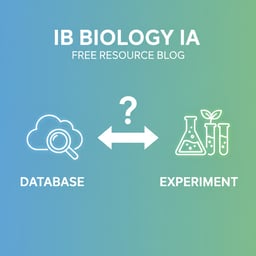
IB Biology IA: Database vs. Experiment
Master your IB Biology IA: Compare hands-on experiments vs. database investigations. Get reliable public database sources (like GenBank) and 10 sample research questions to start your high-scoring IA immediately.
IB Biology IA: Database vs. Experiment – Your Guide to a High-Scoring Investigation
As an IB Biology expert, I know firsthand the pivotal role your Internal Assessment (IA) plays in your final grade. It’s your chance to truly embody a scientist, moving beyond textbook knowledge to conduct independent research. The critical first step? Choosing the right approach: a hands-on experiment or a modern database investigation.
This guide will demystify both IA avenues, provide reliable data sources, and spark your inspiration with compelling research questions to help you get that top score.
Your IA Mastery Roadmap
This guide is designed to empower you to make an informed decision about your IB Biology IA, setting a strong foundation for a high-scoring submission.
By engaging with this resource, you will be able to:
- Understand the Core Differences: Clearly distinguish between experimental and database-driven Internal Assessments, recognizing the unique demands and opportunities of each.
- Identify Your Strengths: Evaluate which IA approach best aligns with your interests, available resources, and skill set, maximizing your potential for personal engagement and depth.
- Navigate Reliable Data Sources: Discover reputable public databases that offer a wealth of biological data for sophisticated investigations.
- Formulate Winning Research Questions: Get a head start with 10 sample research questions, designed to inspire focused, measurable, and biologically relevant inquiries for both experimental and database IAs.
The IB Biology IA: More Than Just a Lab Report
The IB Biology IA is an individual scientific investigation contributing 20% to your final Biology grade. It's an opportunity to develop a focused research question, design a method, collect and process data, analyze results, and critically evaluate your findings. For assessments starting from May 2025, the IA has a maximum word count of 3,000 words.
Whether you choose an experiment or a database investigation, the core criteria remain consistent: a clear research question, robust methodology, comprehensive data collection and analysis, critical evaluation, and effective communication.
The Experimental IA: Hands-On Discovery
The traditional experimental IA involves designing and conducting a practical laboratory or fieldwork investigation to collect primary data. This approach allows for direct manipulation of variables and a tangible experience of scientific inquiry.
Pros of an Experimental IA
- Direct Control & Personal Engagement: You have direct control over variables and the experimental setup, fostering a strong sense of personal engagement. This hands-on experience can make the scientific process feel more tangible and rewarding.
- Clear Methodology: Designing your own experiment often leads to a very clear and replicable methodology section, a key component of the IA.
- Qualitative & Quantitative Data: You can often collect both quantitative (numerical) and qualitative (descriptive) data, providing a richer dataset for analysis.
- Familiarity: Many students are more familiar and comfortable with the experimental design process from their regular lab work.
Cons of an Experimental IA
- Time & Resource Intensive: Experiments can be time-consuming, requiring significant effort in setup, data collection, and potential troubleshooting. Access to specific equipment can be a limiting factor.
- Ethical & Safety Considerations: Certain investigations, especially those involving live animals or human subjects, come with strict ethical guidelines that must be rigorously followed.
- Unforeseen Challenges: Experiments don't always go as planned. Unexpected results, failed trials, or equipment malfunctions can add stress and require flexibility.
- Data Quantity: Generating sufficient, high-quality data (e.g., at least 5 variations and 5 repeats for continuous data) can be challenging within school lab constraints.
The Database IA: A Modern Approach
A database investigation, also known as a secondary data investigation, involves extracting and analyzing existing data from reputable online databases. This approach leverages vast datasets collected by other researchers, offering a different lens for biological inquiry.
Pros of a Database IA
- Access to Vast & Complex Data: Databases offer access to enormous datasets that would be impossible to collect individually (e.g., genomic data, global health statistics). This allows for investigations into complex biological phenomena on a larger scale.
- Time Efficiency: The time spent on physical data collection is significantly reduced, allowing more focus on data processing, analysis, and evaluation.
- Reduced Ethical & Safety Concerns: Generally, database investigations carry fewer ethical and safety concerns compared to hands-on experiments.
- Developing Data Analysis Skills: This approach strongly emphasizes advanced data processing and statistical analysis skills, which are highly valued in modern biology.
Cons of a Database IA
- Data Reliability & Limitations: You must critically evaluate the reliability and methodology of the data sources. Understanding potential biases is crucial.
- Finding a Unique Angle: With readily available data, it can be more challenging to develop an original research question and demonstrate personal insight.
- Complexity of Analysis: Large datasets often require more sophisticated statistical tools and a deeper understanding of data interpretation.
- Less "Hands-On" Engagement: Students who enjoy the practical, laboratory aspect of science might find a database IA less engaging.
Key Considerations for Choosing Your IA Type
So, how do you decide? Walk through these five points to find the best fit for you.
- Personal Interest: What genuinely excites you? Your enthusiasm will shine through and make the process more enjoyable.
- Available Resources: Consider the equipment and time available in your school lab, as well as your access to reliable internet and data analysis software.
- Data Analysis Skills: Be honest about your comfort level with statistics. Database IAs often demand more advanced statistical manipulation.
- Ethical Implications: Carefully review the IB's ethical guidelines. If your idea involves human or animal subjects, ensure it's permissible.
- Teacher Guidance: Your Biology teacher is an invaluable resource. Discuss your ideas with them early and often to ensure your project is feasible.
Reliable Public Database Sources
When embarking on a database IA, the quality and reliability of your data sources are paramount. Here are some highly regarded public databases suitable for IB Biology investigations:
- GenBank (NCBI): A comprehensive public repository of nucleotide sequences. Ideal for genetic, evolutionary, and molecular biology studies.
- Protein Data Bank (PDB): Stores 3D structural data of proteins and nucleic acids, useful for investigations into protein function and enzyme mechanisms.
- World Health Organization (WHO) Global Health Observatory (GHO): Provides a vast array of health-related data, including disease incidence, mortality rates, and health indicators. Excellent for epidemiology and public health IAs.
- FAOSTAT (Food and Agriculture Organization of the UN): Offers free access to food and agriculture data for over 245 countries, covering topics from crop production to nutrition.
- NOAA Climate and Weather Databases: Contains extensive environmental data, including climate patterns and oceanographic data, suitable for ecological or environmental biology IAs.
- UniProt: A high-quality, freely accessible resource of protein sequence and functional information.
- eBird: Contains counts of bird species around the world, as well as arrival and departure dates for migrating species.
- Gapminder: Provides global development statistics, useful for exploring correlations between biological and socio-economic factors.
10 Sample Research Questions to Ignite Your IA
A strong research question is focused, measurable, and biologically relevant. Here are some examples to get you thinking. Notice how they clearly identify the independent and dependent variables.
Sample Experimental IA Research Questions
- To what extent does varying the concentration of sodium chloride (NaCl) affect the rate of osmosis in potato (Solanum tuberosum) tissue, as measured by percentage change in mass?
- How does altering the pH of a solution impact the activity of catalase from corn (Zea mays), measured by the volume of oxygen gas produced?
- What is the effect of different light intensities on the rate of photosynthesis in Canadian waterweed (Elodea canadensis), quantified by the number of oxygen bubbles produced per minute?
- How does the concentration of sucrose affect the respiration rate of baker's yeast (Saccharomyces cerevisiae), measured by the volume of carbon dioxide produced?
- To what extent does the presence of different heavy metals (e.g., copper, lead) influence the germination rate of wheat (Triticum aestivum) seeds?
Sample Database IA Research Questions
- Is there a correlation between a country's Human Development Index (HDI) score and its incidence rate of Type II diabetes, using data from the WHO and UN?
- How does the average annual temperature in different geographical regions correlate with the genetic diversity of the COI gene in Drosophila melanogaster, using data from GenBank and NOAA?
- To what extent has the global production of palm oil (FAOSTAT data) impacted the population trends of endangered Bornean orangutans (IUCN data)?
- Is there a significant relationship between historical atmospheric CO2 levels (NOAA data) and the timing of spring flowering dates for European beech (Fagus sylvatica), using ecological monitoring databases?
- How does the genetic variation in the CYP1A1 gene (GenBank data) differ among human populations residing in areas with high versus low levels of air pollution (WHO data)?
Choosing your IB Biology IA topic is the first exciting step on your scientific journey. Whether you opt for the hands-on thrill of an experiment or the analytical depth of a database investigation, remember that clarity, rigor, and genuine interest are your greatest assets. Good luck!
.png?width=289&height=306&name=%E5%A4%B4%E5%83%8F%20copy%20-%20Siwen%20(Rose).png)
Hi, I’m Huaijin (Rose), an IB graduate with 42 points who works as a part-time IB tutor. I achieved 7s in Chemistry, English B, Math, and Geography, and I’ve been tutoring IB students for over 5 years. I like to use concrete examples to explain abstract concepts and to provide structured support to my students. I also enjoy getting to know my students personally and accompanying them with emotional encouragement throughout their academic journey. Outside of tutoring, I love writing, reading, travelling, and playing guitar.
Why Lanterna?
An experimental Biology IA involves designing and conducting a hands-on investigation to collect primary data, often in a lab or field setting. A database IA, on the other hand, utilizes existing secondary data from reputable online sources (like GenBank or WHO) for analysis. Both approaches require a clear research question, rigorous methodology, and insightful analysis.
Your decision should hinge on your personal interest, available resources (e.g., lab access, specific equipment, software), and your comfort level with data analysis. If you enjoy hands-on work and direct variable manipulation, an experimental IA might suit you. If you prefer working with large datasets and advanced statistical analysis, a database IA could be a better fit. Discussing your ideas with your Biology teacher is also crucial.
A common pitfall is choosing a topic that's either too broad to manage or too narrow to generate sufficient data. For experimental IAs, ensure you can meet ethical guidelines and collect enough high-quality data within time constraints. For database IAs, critically evaluate the reliability of your data sources and ensure your analysis goes beyond simple correlations to offer genuine biological insight. Underestimating the time commitment for either approach is also a frequent mistake.
Several highly reputable public databases are excellent for Biology IAs. These include GenBank (for genetic sequences), Protein Data Bank (for protein structures), WHO Global Health Observatory (for health statistics), FAOSTAT (for agriculture data), and NOAA (for climate and environmental data). Always ensure you understand the data's origin, methodology, and potential limitations, and cite your sources rigorously.
Our expert IB Biology tutors, all high-achieving graduates, provide personalised guidance tailored to your IA. We help you refine your research question, structure a robust methodology, ensure appropriate data collection and analysis, and craft a compelling evaluation. Whether you're navigating experimental design or processing complex database information, we ensure your IA showcases your full scientific potential.
Absolutely. A strong, focused research question is the cornerstone of a high-scoring IA. Our tutors are experts at helping students develop questions that are not only measurable and biologically relevant but also allow for sophisticated investigation and analysis. We ensure you start your IA journey with clarity and confidence, setting you up for success.
It's a free, 20-30 minute one-on-one session with one of our dedicated Student Success Experts. This consultation is designed to understand your unique academic situation, identify your strengths and challenges within the IB Diploma, and provide you with clear, actionable advice and strategies for your studies, including specific guidance on your Biology IA.
Yes, it's genuinely free, with absolutely no obligation to purchase tutoring. We offer these consultations because we believe every IB student deserves access to expert guidance. Our primary goal is to empower you with a clear study plan, prioritized next steps, and increased confidence, helping you feel less stressed and more in control of your IB journey.
Our Student Success Experts are experienced education advisors who possess an in-depth understanding of the entire IB Diploma Programme. They act as your personal guide, helping you map out effective study strategies, understand complex requirements like the Biology IA, and identify if and how personalised tutoring could provide significant support for your academic goals.
It's ideal to book a consultation early in your IA process. This could be when you're brainstorming topics, weighing the pros and cons of an experimental versus database approach, or if you're struggling to formulate a strong research question or initial methodology. Our experts can help you establish a robust plan and ensure you're on the right track for a high-scoring IA.
Absolutely. Lanterna provides comprehensive, personalised support across all IB subjects, both Standard Level (SL) and Higher Level (HL). Our expertise extends to helping with Extended Essays (EE), Theory of Knowledge (TOK) essays and presentations, exam revision, and developing effective study skills. Our global team of tutors and experts is dedicated to supporting your entire IB journey, helping you achieve your full academic potential.
More free resources

IB Biology IA Topic Ideas: 30+ Examples to Inspire You
Struggling with your IB Biology IA? Discover 30+ expert-curated IB Biology IA Topic Ideas and examples to inspire your research and help you secure a top grade.

How to Get Top Marks on Your IB Biology IA
Get top marks on your IB Biology IA. Learn the 5 crucial components, from personal engagement to data collection, with expert tips on grading criteria.
Complete Guide to the IB Biology IA: Tips & Ideas
Nail your IB Biology IA with expert tips from a high-scoring tutor. Learn how to plan your lab, avoid complexity, and get 10 Bio IA topic ideas.
Ultimate IB Biology Study Guide
Ace the IB with this free, comprehensive Biology Study Guide. Written by 7/7 HL graduates, it features exam strategies, top resources, and expert insights.

How to study IB Biology: 5 essential tips
Learn how to study IB Biology effectively with 5 essential tips from an expert tutor. Master diagrams, vocabulary, and linking topics for successful revision.
Mastering IB Biology Paper 2: A Step-by-Step Guide
Mastering IB Biology Paper 2 starts here. Learn the structure, key command terms, and expert exam technique to maximise your marks in the IB exam.

How to Get a 7 in Your IB Science IA
Learn how to master your IB Science IA and achieve a 7 with expert tips on the Research Question, Personal Engagement, and clear Communication for top grading.

IB Science IA: 5 Top Tips on How to Get Started
Stop procrastinating on your IB Science IA! Learn 5 top tips for starting your Internal Assessment, including how examiners grade personal engagement and research questions.
Professional Support for the Final Push
GRADUATES
TEACHERS
EXAMINERS
BOOK A FREE CONSULTATION TODAY
Stockholm based, supporting students worldwide. We are IB experts committed to achieving your academic goals.
ABOUT US