-1.png?width=150&height=56&name=logotype_lanterna_education_blue%20(4)-1.png)
This week, I’ll take you through the optimised note taking process! This will turn those useless, confusing sheets of muddled notes into a life-saver revision resource.
To spice it up, I’ll also show you how I combined my note taking with active revision, cementing any information I was learning so that it’s there, in the back of my mind, in the exam. You won’t want to miss this, it might save you hours upon hours, and will most likely earn you marks!
Repetition, Repetition, Repetition.
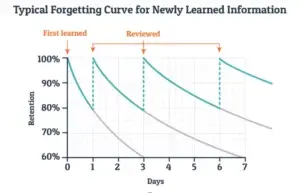
The above graph shows you how I learned pretty much all content for my IB exams – really. Day 0 is when you learn it in class, and over the following week you have to repeat the content 2/3/4 times. Very simple, yet very effective. By the way, “repeat” means anything from just re-reading, to creating original resources – but more about that in a second.
The amount of repeats you do depends on how tricky you find the topic, but I would recommend at least 2 repeats – day 2 or 3, and day 6 or 7. Try to find the number of repeats that work for you.
If this method sounds tedious and complicated so far, don’t worry! I thought the same. Simply read on to find out how to integrate this method of learning directly into your note-taking!
1. Note Taking in Class
Sometimes you hardly have to pick up a pen in class, however there are times where the content just doesn’t stop piling up during the lesson. It’s in these scenarios, and in class generally, it’s most important just to get everything on the page.
In effect, in whichever way you can, you need to get all the info down – it doesn’t have to look pretty, and it doesn’t even have to make total sense – all that’s important is that when you go back to those notes, you at least know what you were on about.
Priority number one is to not get distracted, and just get the info down. If the content in class doesn’t make sense, make sure to ask your teacher at the time! If you don’t, your notes might as well be written in hieroglyphics, and won’t be useful at all the second you leave the classroom. The balance between note-taking and listening is difficult to get right – with practice, you’ll be able to do both simultaneously!
I always find it useful to write any examples, websites, or resources for further reading that your teacher suggests in the margin. Always note these down, as you never know how useful it might be later – particularly to fill in any knowledge you might have missed as you were taking those notes.
2. Note Condensation
So far we only have our page of basic, untidy notes. Think forward to your final exams now: Will these notes actually help you when you need to refresh your knowledge, while stressed, the night before? Of course not!
We need to condense our notes! Trim away any unnecessary information (use the syllabus, your teacher and textbooks to know what’s not wholly useful) and make it easy to understand. Here’s what you need:
- Clear headings, ideally bold and in-colour – you won’t want to have to flick through hundreds of pages of untitled notes just to find one piece of info. It needs to be easy to find what you’re looking for. Use the syllabus to know which topic you’re working on.
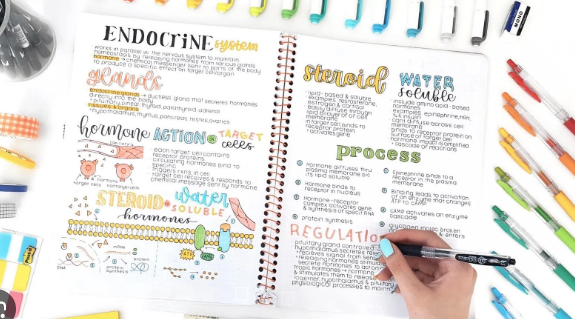
- Beautify it! – Now is your chance to turn your basic notes into a visually appealing revision resource. Use colours, lay the page out in a logical manner, highlighting important equations and other pieces of essential info. The rest of the notes can revolve around these elements.
- Diagrams – a must for sciences and maths, keep diagrams large enough to annotate, and use colours where appropriate. You do, however, want to make sure your notes have enough breathing space – a page packed full of lines and bright colours might just give you a headache instead.
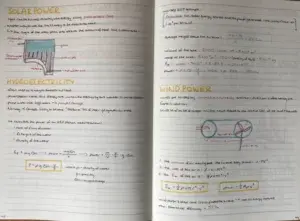
These notes are now ready to be picked up in a panic the night before a big exam!
Note condensation counts as a repeat! So, if you did this the day after you originally learned the content, that’s repeat 1 done already. You can condense your notes on any of the days – but I strongly recommend you don’t skip it, and do it as soon after the lesson as possible.
3. Recall
The rest of the process involves repeating the information the remaining times to ensure it’s there to stay. Perhaps you could make flashcards based on your condensed notes – this is a great idea, as it’s yet another repetition and you can then use those cards for active recall.
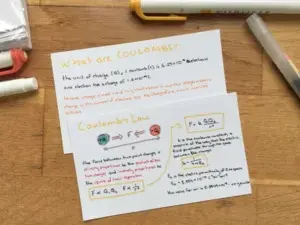
Active recall is a great way to learn information for the long-term. Click here to read a more comprehensive overview of active recall, with a useful examples to help inspire you.
Try to add variation to those other repeats. Yes, in theory, you could just re-read your notes, but this won’t be as effective as teaching the topic to a friend yourself, or testing yourself using flashcards and past paper questions. Be as active as you can!
Final Word
I’d recommend coming back to each topic perhaps a month after you do this. For example, my repeats were: Day 1 – 3 – 7 – 30, and then a top up before the exam. In total, I learned and refreshed the content 5 times. Give it a try, and don’t be afraid to adapt this strategy so it fits your life.

We’re the Lanterna Team — a group of 600+ IB expert tutors, ranging from 45/45 IB graduates to IB teachers with 30+ years of teaching and examiner experience.
For over 20 years, we’ve supported tens of thousands IB students worldwide with one clear focus: making high achievement feel more doable. Our team of experienced tutors have come together to combine their deep curriculum knowledge with practical strategies that are proven to work.
Whether you’re building strong foundations in DP1, pushing for a final stretch in DP2, or looking for clarity on what to prioritise, we’re here to help you study smarter, stay confident, and get results.
.png)
Ultimate IB Note-Taking Guide
Master IB note-taking with the ultimate guide. Discover top methods (Cornell, mind maps) and review essential apps (Notion, OneNote) to boost revision and study efficiency.
How to Take the Best IB Notes: SCOR E Steps
Learn how to take the best IB notes using the expert SCOR E steps: Select, Condense, Organise, Revisit, Engrain. Essential IB revision tips for success.
How to Take Effective IB Notes
Learn how to take effective IB notes with expert revision tips on content and form. Discover methods like Cornell, visual diagrams, and flashcards for better studying.

How to Take Effective IB Notes: A Step-by-Step Guide
Learn how to take effective IB notes with expert tips on condensing information, sticking to essentials, and using your own words. Ace your IB revision and exams.

Top 5 IB Study Apps & Websites to Boost Your Learning
Boost your IB study sessions with our top 5 IB study apps and websites recommended by expert tutors. Get better time management, effective revision tips, and control over assignments.
How to Create the Perfect IB Study Environment
Learn how to create the perfect IB study environment, boost concentration, and avoid distractions like background noise and phones. Essential revision tips for IB students.

How to Master IB Revision: Key Skills and Strategies
Master your IB revision: Learn key skills and strategies, from setting goals and creating effective timetables to specialized revision tips for content and concept-heavy subjects.

How to Achieve a Study-Life Balance in IB
Learn how to achieve a healthy study-life balance in the IB with non-cliché, actionable revision tips from an expert tutor who scored 41 points while still having fun.