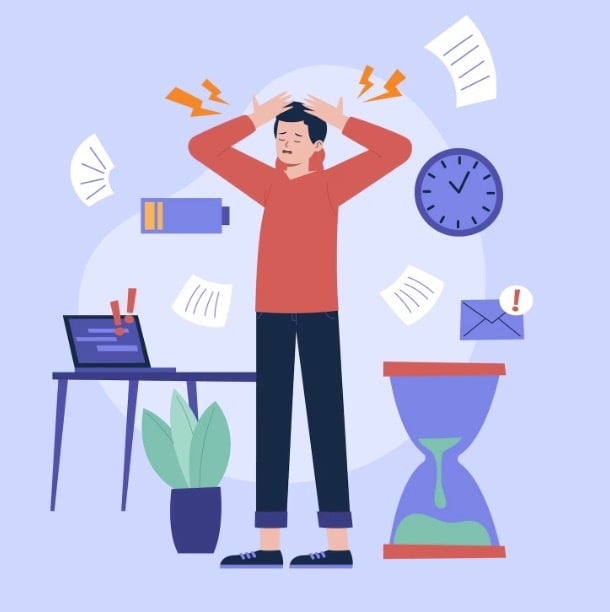
There are many clichés when it comes to study-life balance. I imagine no one reading this would be surprised if I told them that to have a healthy study-life balance in the IB, they should limit screen time, sleep well and do 100 push-ups daily. This is all true, of course, but radical lifestyle changes like that are a hard pass for most, including me. While I’m sure I would achieve some impressive levels of brainpower if I woke up at 6 AM to work out after downing my spinach smoothie, I’d rather not. So, what can we stressed-out mere humans do?
In this post, I will share my tips for staying productive during the IB and having fun. I managed to get 41 points whilst enjoying myself. I know many of my fellow tutors did even better and enjoyed the ride, too! I will keep all these tips actionable and non-cliché, so you might actually feel incentivised to try them out.
Keep in mind that this is what worked for me. You will have to adapt this to suit you! And who knows, you may disagree with something I say. That’s all right; everyone studies most efficiently in different ways. I hope this helps you find yours.
You Don’t Have to Feel Great to Study
Sometimes, we just really don’t feel like studying. Picking up the textbook is about the last thing you want to do. I had this a bunch. Especially when I was feeling down, I would just not do anything. “I won’t be able to do it well, anyways,” I would tell myself. So, I turned to doom-scrolling instead.
The thing is that we don’t have to feel great to get something done. It’s OK only to muster 30% of your usual performance. Then you just revise a little bit at 30%. It is still much better than nothing. Usually, pushing past the inertia of starting gets you more motivated, too.
Any tiny bit you get done helps. There is this apt saying that goes:
“How do you eat an elephant? Bit by bit”
If I could go back in time, I would tell myself just to get a little bit done when feeling down. I would also remind myself that I could find enjoyment in what I was doing. Okay, I just said no clichés, but this one is important. Remember that these IB subjects can be kind of fun. There is no need to build a mental fortress against enjoying school; it is easier to push yourself when you like what you are doing.
Don’t Plan Out Every Single Revision Session
It’s natural to grab your calendar and start writing out a “perfect” revision schedule for the weeks to come. “Monday, I will do 3 hours of calculus. Tuesday, I will do the May TZ1 2019 HL Chemistry Paper 2. And Wednesday, I will make some history flashcards about Mussolini.” Sounds good, right? There are a few problems with this approach, though.
If you have ever written a plan like this, you will know how hard it is to stick to it. Life is unpredictable, and you can quickly get a day or two behind. Soon, you will be playing an endless game of catch-up.
Students also tend to misjudge how much work they can do any day. Either they will allocate 3 hours when their focus only lasts for 20 minutes or stop while they are still focused and enthusiastic.
This is a very stressful way of planning out your study-life balance. You will always feel like you aren’t ‘doing what you’re supposed to’.
Having a Good Study-Life Balance is to be Less Rigid
The key is to have a less rigid plan. You don’t know which topics future you will need to pay more attention to, nor do you know how much energy you will have.
Instead, try turning revision into a habit and figure out what you want to study by estimating which subjects need the most attention. Ali Abdaal popularised the retrospective timetable as a means to that end.
Instead of having every study session planned out weeks in advance, just decide that you will sit down and study after dinner. See what makes sense to study at that moment by referring to your retrospective timetable. Don’t decide for future you (a person that doesn’t even exist yet) what they should prioritise.
While I criticised calendar (mis)use, they are still a potent tool. You absolutely should be using one. The key is to use it right! Writing down deadlines and blocking out revision time is still useful. Just don’t make an unrealistic plan you cannot follow without stressing out.
Don’t Plan to Procrastinate
There is something innately satisfying about filling out a calendar, though. I mean, how good does it feel to write out a colourful to-do list? How good does it feel to write down which papers you want to practice and when? I felt like I was getting stuff done whenever I did that. Except, of course, I wasn’t. I never really followed through with my way too specific plan anyways.
At some point, I continually added to my to-do list and calendar in order to procrastinate. To-do lists are helpful, yes, and keeping one is a great way to stay on top of what you need to do. Just be mindful not to use it as a means of procrastination.
Have you ever written something on a to-do list just to cross it out? Yeah, me too. That’s the ultimate form of procrastination.
The Study-Life Balance Dilemma: Relaxing vs Working
Okay, enough feeling bad about not doing enough. Let’s relax a little! But wait, how do I know I am not relaxing too much? Should I be working on my IA, EE, or that other IA?? Am I relaxing the right way?
Yeah, this is a hard one. The best advice I have for this is to keep yourself disciplined. Make sure that you have the things you have to get done. A to-do list is great for this (just don’t use it to procrastinate!). This way, you can wind down when you relax. Say to yourself that you have done all you can for now and that the rest will have to wait for a little. Rest is essential and entirely achievable if you stay on top of your deadlines.
Study-Life Balance vs Technology
We must address the elephant in the room. Not the one we were planning on eating earlier, but the one that is almost always in your pocket. Your phone.
Your phone can be a great help and a great problem in your study-life balance. As much as I’d love to tell you to downgrade to a non-smartphone (a stupidphone?), that’s just not realistic. And you would also miss out on the fantastic free study apps you can have on your phone!
One tip I have found helpful is only to allow myself to watch something together with other people. Credit goes out to Ali Abdaal again. This makes watching series a social endeavour and takes away a significant procrastination source.
Not everyone will study optimally the way I do. However, I hope this in-depth blog post has given you at least some pieces of inspiration you hadn’t thought of before. Now go and revise; remember that any amount is worthwhile!
-1.png?width=150&height=56&name=logotype_lanterna_education_blue%20(4)-1.png)


.png)