-1.png?width=150&height=56&name=logotype_lanterna_education_blue%20(4)-1.png)
IB History Ultimate Guide
Master the IB History exam & IA with expert revision techniques (dates/themes) and investigation steps. Overcome exam anxiety and coursework struggle in one guide.
The IB History Ultimate Guide: Master Your Exams & IA with Insider Strategies
Navigating the IB History course can feel like traversing a complex historical landscape – vast, intricate, and full of potential pitfalls. As an IB expert and former graduate myself, I know firsthand the challenges of grappling with extensive content, mastering diverse essay styles, and crafting a compelling Internal Assessment (IA).
At Lanterna, we believe that success in IB History isn't just about memorising dates; it's about developing the critical thinking and analytical skills of a true historian. This guide distils years of experience into actionable strategies, empowering you to approach your IB History exams and IA with confidence and clarity.
Your Roadmap to Historical Mastery
This guide is meticulously designed to cut through the complexity of IB History, providing you with the essential tools and insights needed for top marks. By engaging with this resource, you will be able to:
- Deconstruct the IB History Internal Assessment (IA): Understand each component and apply expert-led investigation steps to craft a high-scoring historical investigation.
- Conquer Exam Papers 1, 2, and 3 (HL): Develop targeted revision techniques and exam strategies for source analysis, thematic essays, and in-depth regional studies.
- Integrate Dates and Themes Effectively: Learn how to weave factual knowledge with conceptual understanding to build sophisticated historical arguments.
- Mitigate Exam Anxiety & Coursework Stress: Adopt proven approaches to time management, effective study, and maintaining a healthy mindset throughout your IB journey.
Unlocking the IB History Internal Assessment (IA)
The History IA is your opportunity to shine as an independent historian, exploring a topic of genuine interest. It accounts for 25% of your final grade at Standard Level (SL) and 20% at Higher Level (HL). A well-executed IA can significantly boost your overall score.
The IA Structure at a Glance (2200 words total):
Part 1: Identification and Evaluation of Sources (500 words / 6 marks)
Goal: Clearly state your research question (RQ) and critically analyse two key sources.
- Origin: Who created it? When? Where?
- Purpose: Why was it created? What was its intended audience?
- Content: What information does it contain?
- Value: How is it useful to your investigation? Consider its origin, purpose, and content.
- Limitation: What are its shortcomings? How might bias, perspective, or lack of information affect its usefulness?
Remember: Don't just list values and limitations; explain how they relate to your specific RQ.
Part 2: Investigation (1300 words / 15 marks)
Goal: Present a critical analysis that directly addresses your research question, supported by a range of evidence.
Part 3: Reflection (400 words / 4 marks)
Goal: Reflect on the methods used by historians and the challenges you faced in your investigation.
Mastering the IB History Exams
The external examinations test your ability to apply historical skills under pressure. Understanding the structure and specific demands of each paper is paramount.
Paper 1: Source Analysis (SL & HL)
- Duration: 1 hour
- Weighting: 30% (SL), 20% (HL)
- Focus: Critical analysis and evaluation of historical sources related to a prescribed subject (e.g., The Move to Global War, Rights and Protest).
- Structure: Four compulsory questions.
Question 1a & 1b (3 marks each): Focus on reading comprehension and extracting information from sources.
Question 2 (4 marks): Evaluate the value and limitations of a source based on its origin, purpose, and content (OPCVL).
Question 3 (6 marks): Compare and contrast two sources.
Question 4 (9 marks): A mini-essay requiring you to use all provided sources and your own historical knowledge to answer a question.
Paper 2: Thematic Essays (SL & HL)
- Duration: 45 minutes
- Weighting: 45% (SL), 25% (HL)
- Focus: Writing one essay based on two World History Topics you've studied (e.g., Authoritarian States, Causes and Effects of 20th-Century Wars).
- Structure: You will choose one essay question from a selection.
- Understand the Command Term: "Evaluate," "To what extent," "Compare and contrast," "Discuss," "Examine" – each requires a specific approach to argumentation.
- Craft a Strong Thesis: Your introduction should provide background, acknowledge opposing views, list your main arguments, and clearly state your thesis.
- PEEL Paragraphs: For each body paragraph, use the Point, Evidence, Explanation, Link method. State your point (topic sentence), provide specific historical evidence, explain how the evidence supports your point, and link it back to the question and your thesis.
- Balance and Nuance: Aim for a balanced argument, acknowledging counterarguments or different perspectives, and then critically evaluating them to strengthen your own stance.
- Conclusion: Summarize your main arguments and restate your thesis in a new way, demonstrating how you've answered the question.
Practice is key: Regularly write timed essays to develop speed and structure.
Paper 3: HL Depth Studies (HL Only)
- Duration: 2 hours 30 minutes (150 minutes)
- Weighting: 35% (HL)
- Focus: In-depth essays on one of your chosen regional depth studies (e.g., History of the Americas, History of Europe).
- Structure: You answer three essay questions from a selection within your chosen region.
- Deep Content Mastery: Thoroughly understand your chosen regional syllabus, focusing on key themes, events, and historiography. Use timelines and detailed notes.
- Strategic Selection: Don't try to master all topics; focus on a handful of areas and learn them exceptionally well.
- Planning is Non-Negotiable: Before writing each essay, dedicate 5-7 minutes to planning. Outline your main arguments, key evidence, and thesis statement. This ensures coherence and directness.
- Argumentation & Evidence: Present balanced, well-supported arguments using specific historical evidence (dates, names, events). Integrate different historical perspectives.
- Clear Structure: Each essay needs a strong introduction with a thesis, body paragraphs with clear topic sentences and supporting evidence, and a conclusion that summarizes and ties back to your thesis.
Integrating Dates & Themes: The Historian's Approach
IB History isn't just about rote memorisation; it's about understanding the why and how behind events.
- Contextualise Dates: Don't just list dates; explain their significance and how they connect to broader themes, causes, and consequences. Timelines are excellent for visualizing these connections.
- Identify Overarching Themes: For each topic, consider the major themes at play (e.g., social change, political ideologies, economic impact, conflict). Structure your essays around these themes to demonstrate conceptual understanding.
- Causation and Consequence: Always ask "Why did this happen?" and "What were the effects?" Trace the chain of events and their long-term impacts.
- Change and Continuity: Identify what changed and what remained the same over time. This demonstrates a nuanced understanding of historical development.
Overcoming Exam Anxiety & Coursework Struggle
The sheer volume of IB History can be daunting, but effective strategies can transform your experience.
- Start Early & Be Consistent: History cannot be crammed. Begin revising well in advance, taking active notes throughout the course.
- Active Recall & Spaced Repetition: Instead of passively rereading notes, actively test yourself. Use flashcards for key terms, dates, and figures. Quiz yourself regularly on content from previous weeks.
- Past Paper Practice: This is non-negotiable for all papers. Practice under timed conditions to refine your time management and essay structure. Review mark schemes to understand examiner expectations.
- Break Down the Workload: Divide your syllabus into manageable chunks. Focus on one topic or paper type at a time to avoid feeling overwhelmed.
- Seek Feedback: Regularly submit practice essays and IA drafts to your teachers for constructive criticism. At Lanterna, our expert tutors provide personalised feedback to help you refine your arguments and historical skills.
- Prioritise Well-being: Ensure you get enough sleep, eat healthily, and incorporate breaks into your study routine. Managing stress is crucial for optimal performance.
The IB History journey is challenging, but immensely rewarding. By adopting these expert strategies for your IA and exams, you're not just preparing for a grade; you're developing invaluable critical thinking skills that will serve you far beyond the IB Diploma. Remember, consistent effort, strategic practice, and a deep engagement with the material are your keys to success.

We’re the Lanterna Team — a group of 600+ IB expert tutors, ranging from 45/45 IB graduates to IB teachers with 30+ years of teaching and examiner experience.
For over 20 years, we’ve supported tens of thousands IB students worldwide with one clear focus: making high achievement feel more doable. Our team of experienced tutors have come together to combine their deep curriculum knowledge with practical strategies that are proven to work.
Whether you’re building strong foundations in DP1, pushing for a final stretch in DP2, or looking for clarity on what to prioritise, we’re here to help you study smarter, stay confident, and get results.
Why Lanterna?
The IB History IA is an independent research project where you investigate a historical question, accounting for 25% (SL) or 20% (HL) of your final grade. It's crucial for developing critical historical thinking and significantly boosting your overall score by allowing you to demonstrate your skills as a historian.
This section requires you to state your research question and critically analyse two key sources using the OPCVL method (Origin, Purpose, Content, Value, Limitation). Ensure your research question is focused and debatable, and explain *how* each source's values and limitations directly relate to your specific question and investigation.
Paper 1 focuses on critical source analysis from a prescribed subject. Paper 2 requires you to write thematic essays based on two World History Topics. Paper 3 (HL only) involves three in-depth essays from a chosen regional depth study. Each paper tests distinct historical skills, from source evaluation to comprehensive content application and nuanced argumentation.
Lanterna's expert tutors, many of whom are high-achieving IB History graduates, provide personalised guidance on every IA component. We help you refine your research question, conduct thorough source analysis (OPCVL), structure your investigation for maximum marks, and strengthen your reflection, all while ensuring strict adherence to academic honesty guidelines.
Absolutely. Our tutors are specialists in all IB History papers, covering SL and HL content. We offer targeted strategies for Paper 1 source analysis, Paper 2 thematic essay writing, and Paper 3 in-depth regional studies. We'll help you develop strong arguments, integrate evidence effectively, and manage your time under exam conditions to maximise your score.
Instead of just listing dates, contextualise them by explaining their significance and connection to broader historical themes, causes, and consequences. Structure your essays around overarching themes, demonstrating a nuanced understanding of change and continuity, and the 'why' behind historical events. This moves beyond memorisation to true historical analysis.
Consistent, active study is key – avoid cramming. Utilise active recall, spaced repetition, and extensive past paper practice under timed conditions. Break down the workload, seek regular feedback, and prioritise your well-being. Lanterna's tutors can help build a structured study plan and provide strategies to manage stress, ensuring you approach exams with confidence.
The Lanterna free IB consultation is a no-obligation, 20-30 minute session with one of our Student Success Experts. It's designed to help IB students and parents identify academic priorities, clarify challenges in subjects like IB History, and develop a clear plan for improvement. It's a first step towards greater clarity and confidence.
Our Student Success Experts are highly knowledgeable about the IB programme and its demands. They listen to your specific needs, offer insights into common IB History challenges (like IA structure or essay technique), and help you understand how Lanterna's tailored tutoring support can lead to better grades and reduced stress. They are your first point of contact for personalised guidance.
Yes, the consultation is completely free with no obligation to commit to tutoring. After the session, you'll have a clearer understanding of your next steps and a personalised strategy for your IB History journey or other subjects. If you choose to explore tutoring, our team can then match you with a specialist IB History tutor best suited to your learning style and goals, ready to start whenever you are.
More free resources

Ultimate IB History IA Guide
Master your IB History IA with this ultimate guide. Get high-scoring topic ideas, structure advice, assessment criteria breakdown, and expert tips to avoid common pitfalls and achieve a 7.
Complete Guide to the IB History IA
Master the IB History IA with this expert guide. Learn how to choose a question, structure your analysis, and use our recommended word counts and IA examples.

How to Revise IB History: Study Tips & Strategy
Maximise your IB History study time with expert revision tips and strategy. Learn how to master essay practice and source analysis for Paper 1 and 2 exams.
How to Ace IB History Paper 1 Source Analysis
Master IB History Paper 1 source analysis: Learn expert strategies, decode questions (Q1-Q3), use OPCVL for evaluation, and boost your mini-essay score.

How to Find a Good Research Question for IB History IA
Learn how to find a good research question for your IB History IA using expert tips, clear examples, and a breakdown of the official IB criteria for top marks.
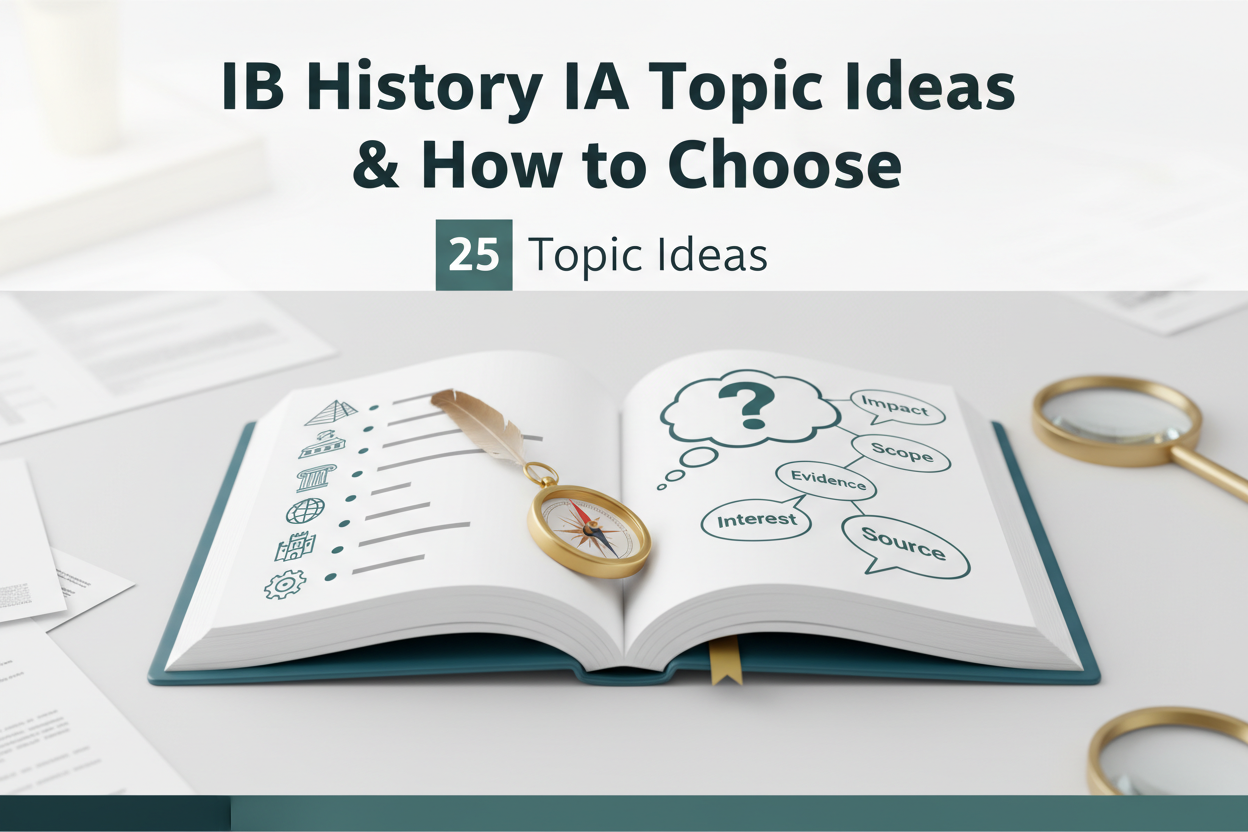
25 IB History IA Topic Ideas & How to Choose
Finding a great IB History IA topic is tough. Learn how to choose from 7 official topic types, use our 12-point checklist, and review 25 high-scoring IA examples.

5 Top Tips for Success with the IB History IA
Master your IB History IA with 5 top tips from an expert tutor. Learn how to choose a strong topic, analyze sources, and structure your essay for top marks.

How to Master IB History: 5-Step Recipe for Success
Master IB History with this 5-step recipe for success! Learn expert revision tips on managing facts, planning essays, and leveraging your strengths for top IB grades.
Professional Support for the Final Push
GRADUATES
TEACHERS
EXAMINERS
BOOK A FREE CONSULTATION TODAY
Stockholm based, supporting students worldwide. We are IB experts committed to achieving your academic goals.
ABOUT US