How to Revise IB History: Study Tips & Strategy
Maximise your IB History study time with expert revision tips and strategy. Learn how to master essay practice and source analysis for Paper 1 and 2 exams.
IB History is a very intense course with loads of material to study, so having a good revision strategy is vital for the exams. Here are some things you can do to maximise your study time.
Take notes in class & study in advance
You simply cannot cram the entire History course the night before the exam. You should begin to revise well in advance – and if you study a bit throughout the two years, most facts should stick to your head by the time you need to revise for your final exams, saving you loads of study time. This also means that you should be taking notes in class or at home throughout the two years to make your revision easier. The last thing you want to do is have no notes or incomplete notes when you sit down for your revision.
Flashcards & Timelines
A great way to memorise all the dates and events is to make your own flashcards and timelines. Timelines are a better option since you can see what was happening at each point in time and how events progressed, which will allow you to analyse your topics in a more global context, making your understanding of history more elaborate. You might even notice connections between seemingly unrelated topics by seeing if they happened during similar time periods.
Essay Practice
Memorising dates won’t be enough to get a good mark in History. Your essay skills need to be perfect for Paper 2 (and Paper 3 if you are doing HL). There are three main things you can do to improve your essay-writing skills:
- Outlines
You don’t really need to write a million essays to practice (although it’s a good idea to do a couple timed essays before the exam to practice time management). Writing down outlines of your answer will help you organise your work, structure your arguments and bring in all the relevant evidence you need in each paragraph. This will help you improve your structure, which is vital for essays, and will also help to recall dates and events. - Critical thinking
IB History essays are argumentative essays, meaning that you need to have a viewpoint on an issue, analyse and evaluate it. Do not spend too much time describing events. Focus on why your evidence supports your claim – but also think of its limitations and possible counterarguments. You need to be critical of your work if you want to achieve a 7. Purely descriptive essays will not score high. - Break down the question
You should always divide the question into three sections: what it wants you to do (e.g. evaluate), the issue at hand (e.g. rise to power) and the subject (e.g. Lenin). It will make the question easier to understand and you will be able to give an answer which is well-focused on the question.
Sporadic source practice
Paper 1 is fully based on your ability to analyse sources, so you should take some time throughout the course to check out different sources – from book extracts to cartoons and propaganda. You can analyse the message of a source or compare and contrast it to another one in a relatively short amount of time, and doing this sort of quick practice will certainly boost your source-analysis skills. Obviously, do a proper Paper 1 practice too when the time of the exam comes nearer.
All in all, if you put in the work, you will be fine. Good luck with your exams!

We’re the Lanterna Team — a group of 600+ IB expert tutors, ranging from 45/45 IB graduates to IB teachers with 30+ years of teaching and examiner experience.
For over 20 years, we’ve supported tens of thousands IB students worldwide with one clear focus: making high achievement feel more doable. Our team of experienced tutors have come together to combine their deep curriculum knowledge with practical strategies that are proven to work.
Whether you’re building strong foundations in DP1, pushing for a final stretch in DP2, or looking for clarity on what to prioritise, we’re here to help you study smarter, stay confident, and get results.
Why Lanterna?
IB History is indeed content-heavy. The key is consistent, early revision throughout the two-year course, not cramming. Focus on active note-taking, creating timelines to connect events, and regularly practicing essay outlines and source analysis. Breaking down the workload over time makes it much more manageable.
Flashcards are excellent for memorising key dates, figures, and events. Timelines take this further by helping you visualise the progression of events and identify connections between seemingly disparate topics. This contextual understanding is crucial for developing the analytical skills needed for higher marks in IB History.
High-scoring IB History essays require strong argumentation, not just description. Focus on developing a clear viewpoint, using relevant evidence to support your claims, and critically evaluating your sources and arguments. Practice outlining essays to structure your thoughts and ensure you address the question directly, breaking it down into its core components.
Paper 1 relies on your ability to analyse and evaluate historical sources. Regular, sporadic practice with various source types (texts, cartoons, propaganda) is key. Focus on understanding the message, purpose, and limitations of each source, and practice comparing and contrasting them. This builds your critical source analysis skills over time.
Ideally, revision for IB History should be an ongoing process throughout the two-year course. By taking good notes and reviewing material regularly, you prevent the need for last-minute cramming. Dedicated exam revision should begin several months before the exams to allow ample time for essay practice and source analysis.
Lanterna's expert IB History tutors, many of whom scored 40+ in the IB or have examiner experience, provide personalised support. They help you develop effective revision strategies, refine your essay writing skills (including critical thinking and structuring arguments), master source analysis for Paper 1, and ensure you understand complex historical concepts, guiding you towards achieving your target grades.
Absolutely. Our tutors specialise in guiding students through the nuances of IB History essay writing. They can help you with outlining, developing strong arguments, integrating evidence effectively, and cultivating the critical thinking necessary to move beyond descriptive writing to analytical excellence, crucial for achieving a 7.
The Lanterna IB consultation is a free, no-pressure 20-30 minute session with one of our expert IB Student Success Experts. It's designed to help you or your child gain clarity on your current IB situation, whether it's about IB History revision, subject choices, or overall study strategies.
Yes, it is genuinely 100% free with no obligation to book tutoring. Our goal is to provide immediate value by helping you understand your challenges and offering a personalised plan for what to focus on next. We believe in empowering students and parents with clear, actionable advice, backed by our team's extensive experience.
Our Student Success Experts are highly experienced IB graduates and educators who understand the IB Diploma inside out. They can help you identify specific areas for improvement in IB History, suggest tailored revision techniques, and provide a clear roadmap for your studies, drawing on their extensive knowledge of the IB curriculum and assessment criteria.
You'll walk away with a clear, personalised plan for your IB journey, specifically tailored to your needs in subjects like IB History. You'll gain clarity on your priorities, understand what strategies to implement (and what to avoid), and feel more confident about your next steps, all backed by the expertise of a team that has supported thousands of IB students.
More free resources

Ultimate IB History IA Guide
Master your IB History IA with this ultimate guide. Get high-scoring topic ideas, structure advice, assessment criteria breakdown, and expert tips to avoid common pitfalls and achieve a 7.
Complete Guide to the IB History IA
Master the IB History IA with this expert guide. Learn how to choose a question, structure your analysis, and use our recommended word counts and IA examples.
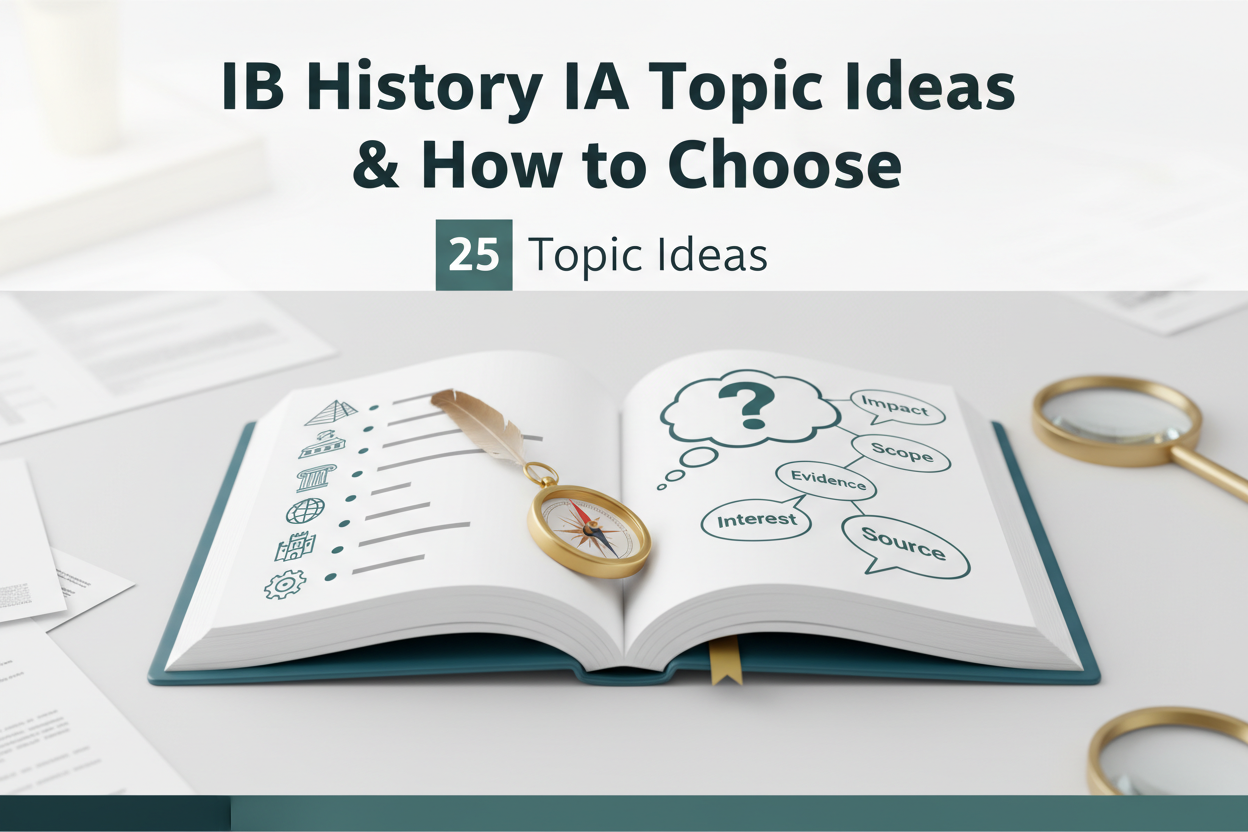
25 IB History IA Topic Ideas & How to Choose
Finding a great IB History IA topic is tough. Learn how to choose from 7 official topic types, use our 12-point checklist, and review 25 high-scoring IA examples.
How to Find a Good Research Question for IB History IA
Learn how to find a good research question for your IB History IA using expert tips, clear examples, and a breakdown of the official IB criteria for top marks.

How to Master IB History: 5-Step Recipe for Success
Master IB History with this 5-step recipe for success! Learn expert revision tips on managing facts, planning essays, and leveraging your strengths for top IB grades.
How to Ace IB History Paper 1 Source Analysis
Master IB History Paper 1 source analysis: Learn expert strategies, decode questions (Q1-Q3), use OPCVL for evaluation, and boost your mini-essay score.
The Ultimate Guide to Acing Your IB Mock Exams
Ace your IB Mock Exams with this free, ultimate guide. Learn expert strategies to prepare effectively, avoid common pitfalls, and maximize your predicted grades.
Last-Minute IB Exam Tips
Master the final days before your IB exams! Get essential last-minute exam tips: what to do and what to avoid (sleep, not cramming new content). from IB 40+ grads.

Professional Support for the Final Push
GRADUATES
TEACHERS
EXAMINERS
BOOK A FREE CONSULTATION TODAY
Stockholm based, supporting students worldwide. We are IB experts committed to achieving your academic goals.
ABOUT US