-1.png?width=150&height=56&name=logotype_lanterna_education_blue%20(4)-1.png)
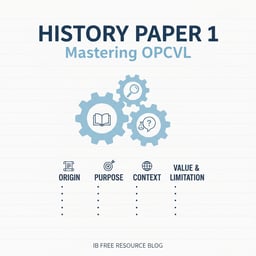
History Paper 1: Mastering OPCVL
Master IB History Paper 1 Source Analysis (OPCVL) quickly. Get the ultimate guide and "Cheat Sheet" of common values/limitations for sources (cartoons, letters, speeches) to write high-scoring paragraphs in under 5 minutes.
History Paper 1: Mastering OPCVL – Your Ultimate Guide to High-Scoring Source Analysis
As a former IB graduate and now an expert IB History teacher with Lanterna Education, I understand the unique challenges and opportunities that come with Paper 1. It's not just about knowing your history; it's about mastering the art of source analysis. Too often, students spend valuable time trying to conjure up profound insights on the spot. But what if there was a way to streamline your approach, armed with insider knowledge that helps you craft high-scoring paragraphs quickly and confidently?
That's precisely what this guide is designed to do. We're breaking down OPCVL, the cornerstone of IB History Paper 1, and equipping you with a "cheat sheet" of common values and limitations for various source types. This isn't just theory; it's practical, proven strategies from those who've aced it.
By using this guide, you will be able to:
- Deconstruct the OPCVL framework into actionable, easy-to-understand steps.
- Identify crucial values and limitations for diverse source types with our expert "Cheat Sheet."
- Learn how to construct high-scoring analytical paragraphs efficiently, often in under 5 minutes.
- Avoid common pitfalls and generic statements that hinder top marks.
- Develop a confident and strategic approach to tackling any Paper 1 question.
Section 1: What is OPCVL and Why Does it Matter?
OPCVL stands for Origin, Purpose, Content, Value, and Limitation. It’s the analytical framework the IB expects you to use when evaluating historical sources in Paper 1. But it's far more than just a checklist; it's a critical thinking tool that allows you to assess a source's utility and reliability for a historian studying a specific topic.
Mastering OPCVL demonstrates your ability to engage with historical evidence critically, understand the nuances of historical interpretation, and recognize how different perspectives shape our understanding of the past. This skill is paramount for achieving top marks in Paper 1.
Section 2: Deconstructing OPCVL – A Step-by-Step Approach
Let's break down each element of OPCVL to ensure you understand what's expected.
- Origin: This is where the source comes from.
- Questions to ask: Who created it? When was it created? Where was it created? What type of source is it (e.g., speech, letter, cartoon, official document)?
- Why it matters: The origin immediately provides context and clues about potential biases or perspectives.
- Purpose: Why was the source created?
- Questions to ask: What was the author's intention? Who was the intended audience? What message was the author trying to convey?
- Why it matters: Understanding the purpose is crucial for identifying bias and determining what the source can tell us, and perhaps more importantly, what it cannot. Was it to inform, persuade, record, justify, condemn, or rally support?
- Content: What does the source actually say or show?
- Questions to ask: What are the main ideas or arguments presented? What specific details, facts, or images are included?
- Why it matters: This is the factual basis of your analysis. You must refer directly to the content to support your claims about values and limitations. Crucially, do not just describe the content; select relevant aspects for analysis.
- Value: How is the source useful to a historian studying the specific question?
- Questions to ask: What can a historian learn from this source? What insights does it offer? How does it contribute to our understanding of the topic?
- Why it matters: Values often stem from the origin and purpose. For example, a speech from a political leader (origin) intended to rally support (purpose) has value as evidence of their ideology and public rhetoric.
- Limitation: What hinders the source's usefulness or reliability for a historian studying the specific question?
- Questions to ask: What information is missing? What biases might be present? How might the source's purpose or origin restrict its scope or objectivity?
- Why it matters: Limitations are equally important. Even the most valuable source has limitations. Recognizing these demonstrates a sophisticated understanding of historical evidence. For example, the same political speech, while valuable for ideology, might be limited by its propagandistic nature.
Section 3: The Lanterna "Cheat Sheet" – Common Values & Limitations by Source Type
This section provides a quick-reference guide to common values and limitations for various source types. Remember to always link these back to the specific question and content of the source.
| Source Type | Common Values | Common Limitations |
|---|---|---|
| Private Letter / Diary |
|
|
| Speech / Public Address |
|
|
| Political Cartoon |
|
|
| Photograph / Painting |
|
|
| Government Document / Report |
|
|
| Newspaper Article |
|
|
| Memoir / Autobiography |
|
|
Section 4: Crafting High-Scoring Paragraphs in Under 5 Minutes
The key to efficiency and high marks is a clear, structured approach to your analysis. Here's a formula that works:
- Topic Sentence (Assertion): Start with a clear statement about a value or limitation of the source in relation to the question.
- Evidence (Content Reference): Support your assertion by directly referencing specific details, quotes, or elements from the source.
- Explanation (Link to OPCVL & Question): Explain how this evidence demonstrates the value or limitation, explicitly linking it back to the source's Origin, Purpose, or Content, and the demands of the question.
- Impact/Significance: Briefly explain the broader significance of this value/limitation for a historian.
Example Paragraph (Putting it all together):
"Source A is valuable to a historian investigating the causes of the Cold War because it provides insight into the Soviet perspective on international relations. This is demonstrated by Khrushchev's assertion that 'capitalism was inherently aggressive and sought global domination.' This is valuable because, given its origin as a speech delivered by a Soviet leader to a domestic audience, its purpose was to articulate the official Soviet stance and justify their foreign policy, thus revealing the ideological underpinnings of their actions against the West. Without such primary accounts, a historian would lack direct evidence of the internal justifications and perceptions that drove Soviet decision-making, which is crucial for understanding the Cold War's origins. However, the source is limited by its inherent propagandistic purpose. As a public address, it aims to unify and galvanize support, likely presenting a one-sided and simplified view of complex geopolitical realities, omitting any self-criticism or alternative interpretations. Therefore, a historian must cross-reference this source with others to gain a balanced understanding of the factors contributing to the Cold War."
Tips for Speed:
- Read the question first: Always know what you're looking for.
- Highlight keywords: In the source and the question, identify key terms.
- Focus on 1-2 strong points: You don't need to list every possible value and limitation. Choose the most significant and explain them thoroughly.
- Practice: The more you practice this structure, the faster and more natural it will become.
Section 5: Common Pitfalls to Avoid
Even experienced students can fall into these traps. Be vigilant!
- Description over Analysis: Simply summarizing what the source says is not analysis. You must explain why it's valuable or limited.
- Generic Statements: Avoid vague phrases like "the source is biased." Instead, explain how and why it's biased, linking it to the origin or purpose.
- Not Linking to the Question: Every point you make about value or limitation must clearly connect back to the specific historical question asked in Paper 1.
- Treating OPCVL as a Checklist: Don't just tick off O, P, C, V, L. Integrate them seamlessly into a flowing analytical argument. The IB is looking for sophisticated engagement, not just identification.
- Ignoring Content: Your values and limitations must always be supported by direct evidence from the source's content.
Conclusion
Mastering OPCVL is not just about getting good grades in IB History; it's about developing essential critical thinking skills that extend far beyond the classroom. By understanding the origins, purposes, and inherent biases of historical evidence, you become a more discerning consumer of information, both past and present.
This guide, built on the insights of Lanterna Education's expert IB graduates, provides the framework and tools you need to excel. Practice regularly, apply the "cheat sheet" strategically, and approach Paper 1 with confidence. With dedication, you'll not only master source analysis but truly appreciate the fascinating complexity of history.

We’re the Lanterna Team — a group of 600+ IB expert tutors, ranging from 45/45 IB graduates to IB teachers with 30+ years of teaching and examiner experience.
For over 20 years, we’ve supported tens of thousands IB students worldwide with one clear focus: making high achievement feel more doable. Our team of experienced tutors have come together to combine their deep curriculum knowledge with practical strategies that are proven to work.
Whether you’re building strong foundations in DP1, pushing for a final stretch in DP2, or looking for clarity on what to prioritise, we’re here to help you study smarter, stay confident, and get results.
Why Lanterna?
OPCVL (Origin, Purpose, Content, Value, Limitation) is the critical analytical framework the IB expects you to use for evaluating historical sources in Paper 1. Mastering it allows you to critically assess a source's utility and reliability, demonstrating sophisticated engagement with historical evidence – a key to achieving top marks.
This guide breaks down OPCVL into actionable steps, provides an expert "cheat sheet" of common values and limitations for various source types, and offers a structured approach to writing high-scoring analytical paragraphs efficiently. It's designed to help you avoid common pitfalls and approach Paper 1 strategically and confidently.
Common pitfalls include describing content instead of analyzing it, using generic statements about bias without detailed explanation, failing to link analysis directly to the specific question, and treating OPCVL as a mere checklist rather than an integrated analytical process. Our guide helps you identify and overcome these challenges.
Yes, with practice and the structured approach outlined in this guide, it's absolutely achievable. The key is to have a clear topic sentence, support it with specific evidence from the source, explain the link to OPCVL and the question, and briefly state the impact. Consistent practice makes this process efficient and natural.
Our free, 20-30 minute IB consultation connects you with a Student Success Expert. For History Paper 1, they can help you assess your current strategy, identify specific areas for improvement in OPCVL application, and discuss how personalized tutoring could refine your source analysis skills, all without any obligation.
Yes, it's genuinely free, with absolutely no obligation to purchase tutoring. It's designed to provide you with a clear plan, priorities, and next steps for your IB journey, whether that involves exploring our support or simply refining your own study methods with expert guidance.
Our Student Success Experts are highly knowledgeable about the IB Diploma Programme. They are dedicated to understanding your unique challenges and goals, offering tailored advice, and helping you build a roadmap for academic success, leveraging insights from top-performing IB graduates and educators.
After your consultation, you'll have a clearer understanding of your strengths and areas for development, particularly for subjects like IB History Paper 1. You'll receive a personalized plan and, if you're interested, information on how Lanterna's expert tutors can provide ongoing support, but the choice to proceed is entirely yours.
Our tutors, many of whom are high-achieving IB History graduates, provide personalized 1-on-1 support. They can work with you on practice papers, provide specific feedback on your OPCVL paragraphs, help you deepen your understanding of historical context for various sources, and refine your analytical writing to ensure you hit top marks consistently.
Absolutely. Lanterna provides expert tutoring across all IB History papers (Paper 2, Paper 3, and the IA) and a wide range of other IB subjects at both Standard Level (SL) and Higher Level (HL). Our tutors are specialists in their fields, ready to support every aspect of your IB Diploma journey, from IAs to final exams.
Our online tutors are selected from the top IB graduates globally and undergo rigorous training. They use interactive online tools, provide tailored resources, and focus on building conceptual understanding and exam technique. This personalized, global approach ensures you receive the highest quality support from anywhere in the world, helping you gain confidence and achieve your academic goals.
More free resources

Ultimate IB History IA Guide
Master your IB History IA with this ultimate guide. Get high-scoring topic ideas, structure advice, assessment criteria breakdown, and expert tips to avoid common pitfalls and achieve a 7.

IB Extended Essay (EE) Guide
What is the Extended Essay (EE)? Get a complete overview of this mandatory 4,000-word research paper in the IB Diploma Programme core.
Complete Guide to the IB History IA
Master the IB History IA with this expert guide. Learn how to choose a question, structure your analysis, and use our recommended word counts and IA examples.
How to Ace IB History Paper 1 Source Analysis
Master IB History Paper 1 source analysis: Learn expert strategies, decode questions (Q1-Q3), use OPCVL for evaluation, and boost your mini-essay score.
25 IB History IA Topic Ideas & How to Choose
Finding a great IB History IA topic is tough. Learn how to choose from 7 official topic types, use our 12-point checklist, and review 25 high-scoring IA examples.

How to Revise IB History: Study Tips & Strategy
Maximise your IB History study time with expert revision tips and strategy. Learn how to master essay practice and source analysis for Paper 1 and 2 exams.

How to Master IB History: 5-Step Recipe for Success
Master IB History with this 5-step recipe for success! Learn expert revision tips on managing facts, planning essays, and leveraging your strengths for top IB grades.

How to Find a Good Research Question for IB History IA
Learn how to find a good research question for your IB History IA using expert tips, clear examples, and a breakdown of the official IB criteria for top marks.
Professional Support for the Final Push
GRADUATES
TEACHERS
EXAMINERS
BOOK A FREE CONSULTATION TODAY
Stockholm based, supporting students worldwide. We are IB experts committed to achieving your academic goals.
ABOUT US