-1.png?width=150&height=56&name=logotype_lanterna_education_blue%20(4)-1.png)
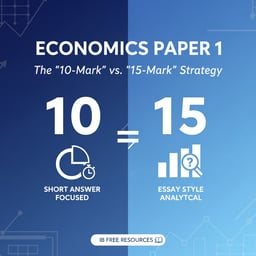
Economics Paper 1: The "10-Mark" vs. "15-Mark" Strategy
Master IB Economics Paper 1 essays. Learn the "DEED" structure (Micro & Macro), and discover strategies to add evaluation, turning your 10-mark answers into 15-mark winners.
Economics Paper 1: The "10-Mark" vs. "15-Mark" Strategy
Welcome, IB Economics students and parents! As a former IB graduate and expert tutor at Lanterna Education, I've guided countless students through the intricacies of Paper 1. This guide distills years of experience into a straightforward strategy that will not only help you master the 10-mark questions but also elevate your responses to consistently achieve those coveted 15-mark scores.
The difference between a good answer and an exceptional one in IB Economics Paper 1 often boils down to a single, critical element: evaluation. This resource will equip you with the tools to seamlessly integrate sophisticated analysis, ensuring your essays stand out.
By using this guide, you will be able to:
- Master the fundamental "DEED" structure for clear, comprehensive 10-mark responses in both Microeconomics and Macroeconomics.
- Identify and apply diverse evaluation techniques to transform a solid 10-mark answer into a high-scoring 15-mark essay.
- Develop a systematic approach to integrating critical analysis and real-world context into your arguments.
- Avoid common pitfalls that prevent students from achieving top marks in evaluation.
Section 1: The Foundation - Mastering the 10-Mark Answer with "DEED"
Before you can excel at 15-mark questions, you must first build a robust 10-mark foundation. The "DEED" structure is a powerful mnemonic our expert tutors at Lanterna advocate for structuring clear, comprehensive answers to "explain" or "analyse" questions. This approach is essential for hitting all the key assessment objectives for Part (a) questions.
Let's break down DEED:
- D - Define Key Terms: Start by clearly defining all relevant economic terms presented in the question. Precision here sets a strong academic tone.
Example: If the question is about "price elasticity of demand," define it accurately. - E - Explain the Theory/Concept: Elaborate on the economic theory. Explain the underlying mechanisms, assumptions, and relationships. Use logical cause-and-effect reasoning.
Example: Explain how changes in price affect total revenue for elastic and inelastic goods. - E - Example: A brief, relevant real-world example is crucial to illustrate your explanation and demonstrate understanding.
Example: For PED, mention luxury goods (elastic) vs. necessities like medicine (inelastic). - D - Diagram: A well-labelled and accurately drawn diagram is a must. It visually represents your explanation and earns significant marks. Crucially, you must refer to the diagram in your explanation.
Example: A demand curve showing the impact of a price change on total revenue.
Why DEED is essential for 10 Marks: This structure ensures you cover the core analytical requirements of knowledge, understanding, application, and analysis. It provides a logical flow, demonstrating a deep understanding of the economic principles before you move on to evaluation.
Section 2: Elevating to 15 Marks - The Power of Evaluation
The extra marks for a 15-mark question come from robust and relevant evaluation. Evaluation moves beyond simply explaining what happens to critically assessing why, when, for whom, and how significant the economic concept or policy is. It's about demonstrating higher-order thinking and a nuanced understanding of economic realities.
In short, evaluation is about asking "So what?" and "What else?"
Key Evaluation Tools & Questions to Ask Yourself:
- Stakeholders: Who gains and who loses from a particular economic event or policy? (e.g., Consumers, producers, government, workers, environment, future generations?)
- Short-run vs. Long-run Impacts: Do the effects change over time? Is a policy beneficial now but harmful later, or vice versa?
- Assumptions & Limitations: What assumptions underpin the theory (e.g., ceteris paribus, rational consumers), and are they realistic? What are the limitations of the policy?
- Magnitude/Significance: How significant are the impacts? Are they large or small? What is the scale of the problem or the solution?
- Alternative Policies/Solutions: Are there other ways to achieve the same objective? Are they better or worse? (e.g., Market-based vs. government intervention).
- Context/Conditions: Does the policy or theory work differently in various economic contexts? (e.g., Developed vs. developing countries, different market structures, political stability).
- Conflicting Objectives/Trade-offs: Does pursuing one economic objective (e.g., growth) conflict with another (e.g., equity or environmental sustainability)? What is the opportunity cost?
Turning a 10-Mark DEED into a 15-Mark Winner
Let's consider a hypothetical question: "Evaluate the effectiveness of a government subsidy in addressing market failure." (15 Marks)
The DEED Foundation (Analysis)
First, you'd explain the core theory:
- Define: Market failure (e.g., positive externalities from education) and a government subsidy.
- Explain: How a subsidy shifts the supply curve downwards/rightwards, lowering the price and increasing quantity, moving output closer to the socially optimal level.
- Example: A subsidy for renewable energy production.
- Diagram: A correctly labelled positive externality diagram showing the subsidy shifting the MPC curve to align with the MSC curve, illustrating the welfare gain.
Adding the 5 Marks of Evaluation
Now, build on this by weaving in critical evaluation points:
- Effectiveness (Magnitude & Limitations): "While subsidies can correct market failure, their effectiveness depends on the magnitude of the subsidy and the elasticity of demand. If demand is highly inelastic, the subsidy may primarily benefit producers through higher revenue rather than significantly increasing consumption."
- Opportunity Cost (Trade-offs): "Furthermore, the funding for subsidies comes from taxpayer money, representing a significant opportunity cost. These funds could have been used for other public services like healthcare or infrastructure, raising questions about government priorities."
- Information Gaps (Limitations): "Governments also face challenges in setting the optimal subsidy level due to information gaps. Over-subsidising can lead to inefficiency and government failure, while under-subsidising may not fully correct the market failure."
- Stakeholders: "While consumers of the subsidised good benefit from lower prices, taxpayers (who may not consume the good) bear the financial burden. Producers gain higher revenue, but may become reliant on government support, reducing incentives for efficiency in the long run."
- Alternative Policies: "Considering alternatives, direct government provision or regulations (e.g., mandating solar panels on new homes) might be more effective in certain contexts, particularly for goods with very large positive externalities."
Section 3: Practical Tips & Common Pitfalls
Even with the right structure, execution is key. Here are some insider tips:
- Time Management is Crucial: You have 1 hour and 15 minutes for Paper 1, which has a 10-mark Part (a) and a 15-mark Part (b). A good split is 25-30 minutes for Part (a) and 45-50 minutes for Part (b). Practice timing yourself!
- Integrate, Don't Isolate: The best evaluation is woven into your analysis, not just tacked on at the end. Use phrases like "However," "Conversely," "The extent to which this is effective depends on..." to transition smoothly.
- Avoid Generic Evaluation: Don't just list points. Link them specifically to the question. Instead of saying "there's an opportunity cost," explain what is being forgone in this specific scenario.
- Use Real-World Examples Strategically: Examiners value the use of real-world examples. Use them not just to explain a concept, but to support an evaluative point about its real-world effectiveness or limitations.
- Know the Syllabus: Remember, Paper 1 questions can be drawn from all four units of the syllabus (Introduction, Micro, Macro, and The Global Economy). You will choose one essay from three options.
Conclusion
Mastering IB Economics Paper 1 is a skill developed through understanding, practice, and strategic application. By consistently applying the "DEED" structure for your analytical foundation and then layering on insightful, context-specific evaluation, you will not only answer the question but truly impress the examiner. The goal isn't just to explain economic concepts; it's to critically assess their real-world implications.
At Lanterna Education, we believe every student can achieve their full potential. Our expert tutors, all high-achieving IB graduates themselves, are here to provide personalised guidance and equip you with the advanced strategies needed to excel in your IB journey.
Disclaimer: This guide provides general strategies for IB Economics Paper 1. Specific syllabus requirements and mark schemes may vary. Always refer to the latest IB Economics Guide and consult your subject teacher for definitive guidance.

We’re the Lanterna Team — a group of 600+ IB expert tutors, ranging from 45/45 IB graduates to IB teachers with 30+ years of teaching and examiner experience.
For over 20 years, we’ve supported tens of thousands IB students worldwide with one clear focus: making high achievement feel more doable. Our team of experienced tutors have come together to combine their deep curriculum knowledge with practical strategies that are proven to work.
Whether you’re building strong foundations in DP1, pushing for a final stretch in DP2, or looking for clarity on what to prioritise, we’re here to help you study smarter, stay confident, and get results.
Why Lanterna?
IB Economics Paper 1 assesses your analytical and evaluative skills in Microeconomics and Macroeconomics. It consists of one essay question, divided into a 10-mark analysis part and a 15-mark evaluation part, requiring deep understanding and critical thinking.
The "DEED" structure is a powerful mnemonic for 10-mark questions: Define key terms, Explain the theory/concept, provide an Example, and draw a relevant Diagram. It builds a strong analytical foundation for your essay responses.
To achieve 15 marks, you must integrate robust evaluation into your 10-mark analysis. This means critically assessing theories and policies by considering stakeholders, short/long-run impacts, assumptions, limitations, and alternative solutions.
Key evaluation tools include analysing impacts on Stakeholders, considering Short-run vs. Long-run effects, identifying Assumptions and Limitations, assessing Magnitude, exploring Alternative policies, and understanding Context and Conflicting objectives.
For the 75-minute Paper 1, it's recommended to allocate approximately 20-25 minutes for the 10-mark (a) part and 45-50 minutes for the 15-mark (b) part. Consistent practice is key to mastering this timing and writing comprehensive answers.
Absolutely. Real-world examples are crucial for demonstrating application and understanding in both the analytical (10-mark) and evaluative (15-mark) sections. They add depth and context, making your arguments more convincing to examiners and showing a nuanced understanding of economic theory in practice.
It's best to start early, ideally from DP1, by consistently applying the DEED structure and evaluation techniques to topics as you learn them. Regular practice with past papers throughout DP1 and DP2 will solidify your skills, build confidence, and ensure you're well-prepared for the exam.
Our expert IB Economics tutors, all high-achieving graduates, provide personalised strategies to master Paper 1. We help you refine your DEED structure, develop sophisticated evaluation, manage time effectively, and apply economic concepts to real-world scenarios for top marks, ensuring you understand exactly what examiners are looking for.
The Lanterna IB consultation is a free, 20-30 minute session with one of our Student Success Experts. It's designed to understand your specific IB challenges, provide a clear study plan, and offer next steps, with absolutely no obligation to purchase tutoring. It's about giving you clarity and confidence for your IB journey.
Yes, it is genuinely 100% free. We believe in providing valuable support to students and parents without any hidden costs or pressure. It's a risk-free opportunity to gain expert insight into your IB progress and potential next steps, tailored to your needs.
Our Student Success Experts are experienced IB graduates who excelled in the programme and are passionate about helping others. They understand the IB journey intimately and are skilled at guiding you through academic challenges, helping you set goals, and connecting you with the right support, whether it's through our resources or tutoring.
Absolutely! Lanterna offers comprehensive support across all units of IB Economics (Micro, Macro, Global Economy, Development) and all papers (Paper 1, Paper 2, Paper 3 for HL) including the Internal Assessment (IA). Our tutors are equipped to help you excel in every aspect of the course, providing tailored guidance no matter your specific needs.
More free resources

How to Structure Your IB Economics IA
Learn how to structure your IB Economics IA commentary perfectly to maximise your grades. Expert tips on analysis, evaluation (CLASPP), and achieving a 6 or 7.
Complete Guide to the New IB Economics Syllabus
Understand the new IB Economics Syllabus changes for 2022. Learn about updated units, Paper 3, and exam weighting/IA grading from an expert IB tutor.

How to Write a Perfect IB Economics IA
Master your IB Economics IA with expert tips on choosing topics, selecting articles, effective structure, and using the CLASPP evaluation method.

How to Ace Your IB Economics Exams
Ace your IB Economics Exams with these expert revision tips and strategies for Paper 1, Paper 2, and Paper 3. Learn how to maximize your score.

How to Get a 7 in IB Economics: 5 Essential Tips
Learn how to get a 7 in IB Economics with 5 essential revision tips from an expert tutor, covering textbooks, structured notes, pre-planned essays, diagrams, and examples.

Ultimate IB Economics Study Guide
Ace the IB Economics exam with this free, comprehensive study guide. Features essential exam strategies, top resources, and expert insights from 7/7 HL tutors.

How to Prepare for IB Exams: Top Tips & Strategies
Learn how to prepare for IB exams with proven strategies and revision tips from an IB graduate. Master planning, self-care, and effective study methods.

How to Plan IB Exam Essays Effectively
Learn how to plan IB exam essays effectively, even when time is tight. Master the simple essay plan grid and expert revision tips for concise, high-scoring responses.
Professional Support for the Final Push
GRADUATES
TEACHERS
EXAMINERS
BOOK A FREE CONSULTATION TODAY
Stockholm based, supporting students worldwide. We are IB experts committed to achieving your academic goals.
ABOUT US