-1.png?width=150&height=56&name=logotype_lanterna_education_blue%20(4)-1.png)
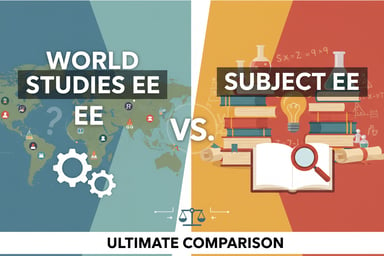
World Studies EE vs. Subject EE: Ultimate Comparison
World Studies EE vs. Subject-Specific EE: Compare the benefits, risks, and global focus of both options to choose the best Extended Essay topic for your success.
World Studies EE vs. Subject EE: Your Ultimate Comparison Guide
Choosing your Extended Essay (EE) path is one of the biggest decisions you'll make in the IB. It’s a 4,000-word research project that sharpens your university-level skills and can make a real difference to your final score. But should you go for a traditional Subject-Specific EE or the more modern Interdisciplinary (World Studies) EE? How do you pick the right one for you?
As former IB grads and tutors, we've helped hundreds of students nail this choice. This guide cuts through the confusion, comparing the pros, cons, and unique focus of each option so you can make a decision that sets you up for success.
This guide will help you:
- Understand the core differences between Subject-Specific and Interdisciplinary EEs.
- Identify the unique benefits each pathway offers for your academic and personal growth.
- Recognize the potential challenges and common pitfalls of each EE type.
- Decide which pathway best fits your interests, strengths, and future goals.
- Prepare key questions to ask your supervisor to get your EE journey started with confidence.
First, What's the Point of the EE?
Before we dive in, let's remember why the Extended Essay matters. It’s your chance to explore a topic you're genuinely passionate about, developing the critical thinking, research, and writing skills you'll use constantly at university. A great EE, combined with your TOK score, can add up to 3 crucial bonus points to your IB Diploma score.
Pathway 1: The Subject-Specific Extended Essay
This is the classic EE route. You conduct your research entirely within the rules and methods of a single IB subject you're taking. Think of it as becoming a mini-expert in a specific academic field.
The Benefits
- Deep Dive into a Single Discipline: If you absolutely love a subject, this is your chance to go deep. You can explore a niche topic that genuinely fascinates you.
- Clearer Methodological Framework: Every IB subject has its own established way of doing things (e.g., experiments in Biology, textual analysis in English, statistical modelling in Economics). This gives you a clear and familiar roadmap for your research.
- Expert Supervisor Alignment: Your supervisor is usually a teacher of that subject, meaning they can offer highly specialised, expert guidance.
- Shows Subject Mastery: A strong Subject-Specific EE is a fantastic way to prove your expertise in a particular field, which looks great on university applications for related courses.
The Risks and Challenges
- The Scope Can Be Tricky: While a "deep dive" is a plus, it can be hard to find a topic that isn't too narrow. You still need enough material to write 4,000 words.
- Avoiding a "Big IA": Your EE must go way beyond your normal coursework. Your research question needs to be complex enough to require genuine, independent investigation, not just a summary of what you learned in class.
- Resource Availability: Sometimes, a super-specific topic might not have enough credible academic sources available for you to build a strong essay.
This is a great fit for you if...
You have a clear passion for one IB subject, you're comfortable with its research methods, and you want to build a strong profile for university studies in that specific area.
Pathway 2: The Interdisciplinary Extended Essay
This pathway, formerly known as the World Studies EE, lets you tackle an issue of contemporary global importance by using the tools and ideas from two different IB subjects. The goal is to connect a big global issue to a specific local example, helping you develop a "global consciousness."
The Benefits
- Tackle Real-World Global Issues: This is your chance to research things that matter right now, like climate change, economic inequality, or public health, and look at them from a critical, academic angle.
- Develop Interdisciplinary Thinking: You learn to connect ideas from different fields to get a more complete picture of a complex problem. This is a massive advantage at university and in the modern workplace.
- Connects the Local to the Global: By studying a local example of a global issue (e.g., "How is plastic pollution affecting the coastline in my city?"), your research becomes more personal, tangible, and often more powerful.
- High Potential for Originality: Mixing two subjects can lead to really creative research questions and unique arguments that wouldn't be possible in a single-subject essay.
The Risks and Challenges
- Achieving True Integration: This is the biggest hurdle. Your EE can't just be two mini-essays stuck together. You have to clearly explain why you need both subjects to properly answer your research question. The integration must be seamless.
- Supervisor Expertise: Your supervisor might be an expert in one of your subjects, but probably not both. You'll need to be proactive in mastering the concepts from both disciplines.
- Staying Focused: Global issues are huge! It can be a real challenge to narrow down your topic and keep your research question focused enough to be covered in 4,000 words.
- Must Be "Contemporary": The issue you choose must be relevant within your lifetime. You can't write a history essay and call it a World Studies EE.
This is a great fit for you if...
You're fascinated by global affairs, you love making connections between different subjects, and you're excited to investigate complex, real-world problems from multiple angles.
The Ultimate Showdown: Subject-Specific vs. Interdisciplinary
Here’s a side-by-side breakdown to help you weigh your options:
| Feature | Subject-Specific Extended Essay | Interdisciplinary Extended Essay |
|---|---|---|
| Focus | In-depth research within a single IB Diploma Programme subject. | A contemporary global issue, explored through two IB DP subjects. |
| Interdisciplinarity | Not applicable; single subject focus. | Essential; requires genuine integration of two subjects. |
| Global Focus | Optional, depending on the subject and topic. | Mandatory; links a global issue to a local manifestation. |
| Methodology | Adheres strictly to the methods of the chosen subject. | Blends methodologies, concepts, and theories from two subjects. |
| Supervisor | Expert in the chosen subject. | Expert in at least one of the chosen subjects. |
| Originality | Achieved through novel application or specific case studies within a field. | Often achieved through unique connections made between two disciplines. |
| Registration | Registered under the specific IB subject (e.g., History, Biology). | Registered under one of six broad thematic areas (e.g., Health and Development). |
Making Your Choice: 5 Key Questions to Ask Yourself
Feeling clearer? To lock in your decision, sit down and honestly answer these questions:
- What am I genuinely passionate about? Is it a single subject I could talk about for hours, or am I more interested in big, complex global problems that cross academic boundaries?
- What are my academic strengths? Do I prefer the clear structure and rules of a single discipline, or do I enjoy thinking outside the box and connecting different ideas?
- What are my future plans? Does my dream university course value deep subject knowledge (Subject-Specific) or broad, flexible thinking (Interdisciplinary)? (Hint: both are highly valued, but one might give you a slight edge depending on the field).
- Can I form a solid research question? For a Subject-Specific EE, can I find a question that's narrow enough to be manageable but has enough depth for 4,000 words? For an Interdisciplinary EE, can I create a question that truly needs two subjects to answer it?
- What support is available? Chat with your teachers. Who could be a good supervisor for your idea? Are the resources (books, data, local experts) you'd need for your topic available?
Your Extended Essay Journey with Lanterna
Whichever path you choose, the EE is a marathon, not a sprint. It's one of the most challenging but also one of the most rewarding parts of the IB. It proves you can think and work like a university student.
At Lanterna, our expert tutors—all IB alumni who have been where you are—provide personalised, one-on-one support to help you nail your EE. From refining your research question to structuring your argument and polishing your final draft, we're here to give you the insider knowledge and confidence you need to succeed. Let us help make your EE journey a highlight of your IB experience.

We’re the Lanterna Team — a group of 600+ IB expert tutors, ranging from 45/45 IB graduates to IB teachers with 30+ years of teaching and examiner experience.
For over 20 years, we’ve supported tens of thousands IB students worldwide with one clear focus: making high achievement feel more doable. Our team of experienced tutors have come together to combine their deep curriculum knowledge with practical strategies that are proven to work.
Whether you’re building strong foundations in DP1, pushing for a final stretch in DP2, or looking for clarity on what to prioritise, we’re here to help you study smarter, stay confident, and get results.
Why Lanterna?
The IB Extended Essay (EE) is a compulsory 4,000-word independent research project. It's a key component of the IB Diploma Programme, offering students the opportunity to explore a topic of personal interest, develop critical thinking, research, and writing skills, and contributes up to 3 bonus points to your overall IB Diploma score.
A Subject-Specific EE focuses on in-depth research within a single IB subject, applying its specific theories, methodologies, and analytical tools. An Interdisciplinary EE (formerly World Studies EE) explores a contemporary global issue by integrating concepts and methods from two IB subjects, often linking a global issue to a local manifestation.
Both Subject-Specific and Interdisciplinary EEs are highly valued by universities as they demonstrate crucial independent research skills. The "better" choice depends on your individual interests and future academic aspirations. A strong Subject-Specific EE can showcase deep mastery in a particular field, while an Interdisciplinary EE highlights critical thinking and the ability to make connections across disciplines.
Our expert tutors, all high-achieving former IB graduates, provide personalised guidance to help you assess your interests, academic strengths, and university goals. We can discuss potential research questions for both pathways, helping you identify the one that aligns best with your academic profile and maximises your potential for a top grade. This is often a great topic for a free consultation with our Student Success Experts.
Absolutely. Crafting a strong, focused, and researchable question is the cornerstone of a successful EE. Lanterna tutors are experts in IB EE criteria across all subjects. We guide you in developing a precise research question and selecting appropriate methodologies, ensuring your approach is robust, academically sound, and poised for success, whether for a single subject or interdisciplinary study.
The main challenges for an Interdisciplinary EE include ensuring true integration of two subjects (rather than simply juxtaposing them), maintaining a focused research question given the broad nature of global issues, and effectively managing research across two conceptual frameworks. Lanterna tutors can provide the strategic guidance needed to navigate these complexities and achieve genuine interdisciplinary insight.
Lanterna is deeply committed to upholding the highest standards of academic honesty and the IB's guidelines. Our tutors provide expert guidance, constructive feedback, and support to help students develop their own research, analytical, and writing skills. We empower students to produce original work, ensuring they understand and adhere to all IB regulations, but we never write essays or sections for them.
The Lanterna free IB consultation is a valuable 20-30 minute session with one of our dedicated Student Success Experts. It's designed to help you clarify your academic goals, identify specific challenges (like choosing your EE pathway), and create a clear, actionable plan for your IB journey.
Yes, absolutely! Our IB consultation is completely free and comes with no obligation to purchase tutoring. During the session, you'll discuss your specific academic needs and aspirations, receive expert insights tailored to your situation, and walk away with a personalised action plan, clear priorities, and strategic next steps for tackling your IB challenges, including your Extended Essay.
Lanterna's Student Success Experts are highly knowledgeable individuals with deep expertise in the IB Diploma Programme. They are dedicated to helping students and parents navigate the complexities of the IB, providing strategic advice, offering guidance on topics like EE choices, and connecting them with the right resources and tutors to achieve their full academic potential.
More free resources

IB vs. A-Levels vs. AP: Ultimate Comparison
IB vs. A-Levels vs. AP: Compare core differences in curriculum, assessment, and university recognition to choose the right pre-university path for your goals.
.png)
IB English: Lang & Lit vs. Lit Ultimate Guide
IB English: Lang & Lit vs. Literature? Compare syllabus, SL/HL assessments, and reading lists to choose the right course for your IB Diploma.

IB Math AA vs AI: How to Choose Your Course
Choosing between IB Math AA vs AI? Our guide compares the syllabus, difficulty, and university prerequisites for both SL and HL. Make the best choice for your future.
.png)
IB SL vs. HL: Smart Subject Choices for University
Master your IB subject choices for university. Get strategic advice on crucial SL vs. HL differences and expert pathways for STEM, Business, and Humanities degrees.

How to Choose IB Higher Level vs Standard Level
Choosing IB Higher Level vs Standard Level subjects is crucial. Learn five expert considerations on workload, university requirements, and IB grading to make the right choice.
IB Extended Essay: Complete Guide to EE Success
Unlock A success with this comprehensive IB Extended Essay guide. Learn the 10 steps to writing a high-scoring EE, from research question to final draft.

IB Extended Essay (EE) Guide
What is the Extended Essay (EE)? Get a complete overview of this mandatory 4,000-word research paper in the IB Diploma Programme core.

How to choose: IB Literature vs. Language & Literature
Deciding between IB Literature and Language & Literature? Learn the exact differences in focus, texts studied, and assessment requirements for IB English A courses.
Professional Support for the Final Push
GRADUATES
TEACHERS
EXAMINERS
BOOK A FREE CONSULTATION TODAY
Stockholm based, supporting students worldwide. We are IB experts committed to achieving your academic goals.
ABOUT US