-1.png?width=150&height=56&name=logotype_lanterna_education_blue%20(4)-1.png)

When it comes to Paper 2 for IB English Lit/Lang and Lit, there are several things that students often find challenging. Some common reactions to seeing a Paper 2 for the first time include:
- ‘The questions don’t make any sense!’
- ‘It’s too broad – I don’t know what they want me to say’
- ‘There’s no way I’m going to be able to remember the right quotes for that!’
Now, these are understandable reactions! Paper 2 can seem a little wacky and abstract, especially after the more relatively straightforward Paper 1 exam. However, if you take the time to unpack what the IB is looking for and follow the tips below, you’ll find that Paper 2 isn’t that bad. With the right preparation, it can be pretty straightforward, after all!
What is the English Paper 2 Exam?
In a nutshell, the IB asks you to write a comparative essay in response to a prompt.
Over the course of the year, whether you are a Lit or a Lang/Lit Student, you will have studied a series of texts. These may be poems, novels, plays or short stories. The Paper 2 exam allows you to draw upon these texts, using them to explore similarities and differences in relation to the central theme of the prompt. For instance,
“Not rounding off, but opening out.” Comment upon the way writers deal with the ending. In your answer, you should refer to two or three texts you have studied.”
Or how about?
Writers utilise a number of different devices within their works, including using time jumps or other non-linear structures. Considering two texts, discuss how writers use structural elements in unusual or interesting ways to shape meaning.”
Okay, these questions may seem a little mean at first, but you only have to answer one question! You will have 1.5 hours if you are a Standard Level (SL) student and 2 hours if you are an English Lit/Lang Higher Level (HL) student!
The key thing to do here is to provide a structured and detailed answer that offers a balanced and meaningful discussion of both texts. Ideally, this means you are identifying 2-3 points of insight from the central questions relevant to both texts. This allows you to write 4-6 chunky paragraphs in answer to the question, in addition to the MANDATORY introduction and conclusion.
What do I need to do to prepare for the Paper 2 Exam?
First of all, planning is essential! You will not know which questions the IB will ask you before opening your exam. However, a quick look over papers from previous years will tell you about the common themes and techniques the IB loves to ask about. Broadly, you can categorise these questions into three groups:
| Themes | Techniques | Meta-textual/Impact |
|---|---|---|
| Authority, love, power, comedy, conflict, underdogs, happiness* | Use of time, beginnings and endings, conventions, paradoxes* | Social message, author’s relationship to characters/audience* |
| E.g. In at least two of the works you have studied, discuss the importance and effectiveness within which the power of dreams are explored. | E.g. What is the purpose of openings in texts? Discuss with reference to two works you have studied. | E.g. “Good literature exposes readers to new perspectives.” Consider how different ideas, opinions and/or beliefs are conveyed in two works you have studied. |
(*By the way, none of these suggested lists are exhaustive! The IB could ask about plenty of other things, but these are the most common!)
Why you should learn more than 2 works
Now, you have a rough idea of what they could ask you. Next, you should go back to your set of texts. Determine which combination of works would work best for you if you had to answer one of these questions.
Some students commit to just learning two works. They rely on their in-depth knowledge of these texts to answer any question that may come up. I understand their approach, but I think having at least two possible combinations of texts available is best (e.g. Text A+B, A+C, or B+C). This ensures you are best prepared to answer questions with reference to the most relevant works.
Also, you certainly don’t want to be stuck giving yourself more to do by exaggerating the importance of one theme/technique in a work because that’s the only one you know!
With these choices made, you can start compiling quotes, context and moments from the texts, which you can use as evidence. Aim for 4-5 really good points of information that you can expand upon in your essay. Even better, if you already know that, you can directly compare/contrast it with a quote/technique from the other piece of work.
For instance, with my Paper 2 exam, I found it helpful to organise my notes in the following layout:
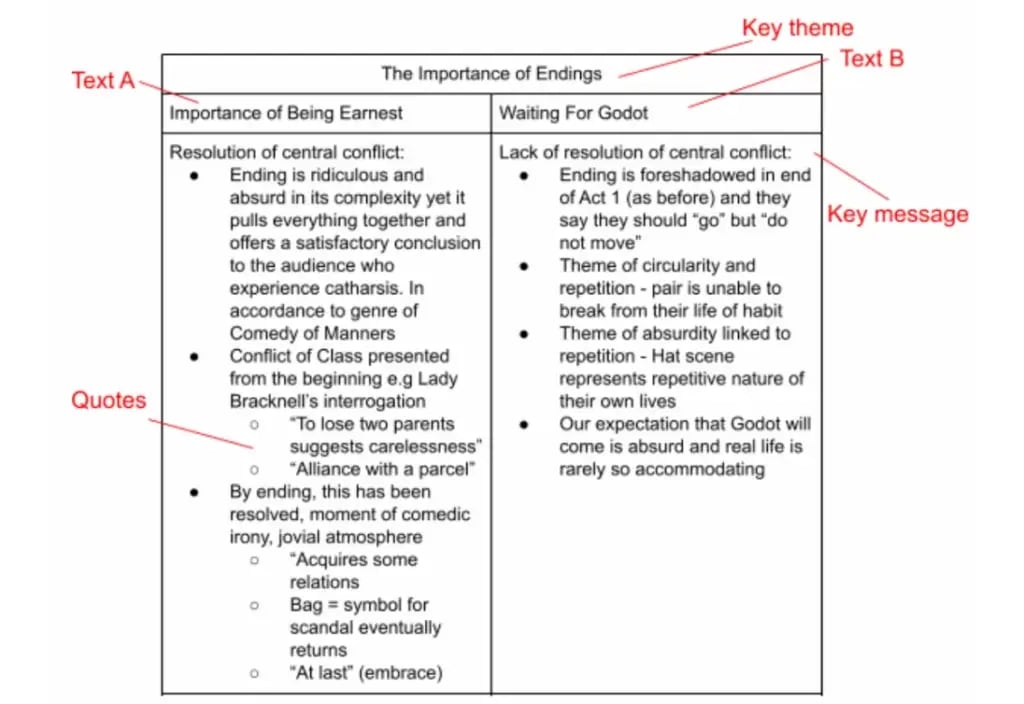
As you can see, I have prepared a mixture of quotations and techniques that I could draw upon for this question on endings. It also allows me plenty of room to elaborate on individual points when I develop new ideas and connections.
Practising Paper 2 Questions
Practising exam questions will help you feel confident writing Paper 2s. Through practice, you will also learn to adapt your prepared notes to specific prompts.
However, before getting stuck in, spend a bit of time thinking about your introductions. An excellent introduction will outline everything you want to cover in your essay, which is key to ensuring you are heading in the right direction. Have a look at the one below and think about all the different criteria it is attempting to reach:
As in all art forms, the ending of a play usually serves to resolve its central conflict, to highlight character development and to convey to the audience a final, lasting message which summarises the major themes and motifs previously seen in the performance. Wilde’s’ Importance of Being Earnest (Importance) appears to display all of these conventions as by the end of the play, the central protagonist, Jack emerges triumphant. However, theatre, as a highly versatile and varied art form, can and has been used to explore radical modernist and postmodernist approaches to art such as in Samuel Beckett’s play Waiting for Godot where these traditional conventions of an ending are questioned. Indeed, while Wilde’s play follows the traditional conventions of an ending in theatre almost to the point of comedic lunacy, Beckett’s play seeks to completely dismiss them. This is undoubtedly the result of the two theatrical productions differing purposes and cultural contexts where Importance clearly belongs to the theatrical genre of comedy of manners while Waiting for Godot is part of the theatre of the absurd. Yet despite these radically different approaches, both highlight the importance of endings as a tool for a playwright to reiterate their main message and to provide the audience with a particular impression to take away.
Sample Paper 2 Introduction by Jay
Criterion A: Knowledge, Understanding and Interpretation
- A clear statement about the writer’s choices and the effects of literary devices. It also sets up the basic structure of the essay to cover three core elements: conflict resolutions, character development and lasting message.
Criterion B: Analysis and Evaluation
- Unambiguous comparative statements about how and why the two texts differ regarding their endings, as well as share similarities.
Criterion C: Focus and Organisation
- The student introduces two key texts and their authors. There is a balanced description of both works, which the student will continue in the main body.
Criterion D: Language
- Spelling, punctuation and grammar is consistently accurate. The student uses a range of vocabulary and relevant, literary/text-specific terminology with precision.
Try to build a habit of writing essay plans with a short introduction. Doing this will help you to turn your notes and ideas into written answers more easily. It will also be an excellent resource for future exam prep!
6 Final Tips
Here are 6 final top tips to keep in mind next time you head into your Paper 2 English Exam!
- Develop Strong Time Management: Time management is crucial during the exam. Allocate a specific amount of time for planning (no more than 20 minutes) and stick to it. Make sure you give yourself enough time to talk about both works in a balanced way.
- Annotate The Question: Highlight key phrases and jot down initial thoughts. These annotations will ensure that you are sticking to the question and mean you won’t have to start with a blank page!
- Develop a Strong Thesis: In the comparative essay, a well-crafted thesis is essential. Clearly state your argument and how you will be referring to both texts in your answer. This will guide your essay and keep it focused.
- Compare Throughout: Every paragraph should start with a comparative, e.g. Both texts explore the theme of loneliness or Unlike text A, Text B utilises its setting to highlight. These topic sentences set you up to dig deeper and explore how these different writers’ choices contribute to the overall meaning and message of the texts.
- Incorporate Literary Devices: Demonstrate your knowledge of literary devices by incorporating them into your analysis. Discuss how these devices enhance the texts and support your arguments.
- Proofread and Revise: Allocate some time at the end of the exam to proofread your essays. Check for grammar, spelling, and clarity. Ensure that your ideas flow smoothly and coherently.
Final Thoughts
I hope this all helps! Remember to prepare for the prompts, test your introductions and focus on critical analysis. If you follow these tips and dedicate yourself to practise, you’ll be in the best possible position to go and ace the English Paper 2 Exam! However, if you want extra assistance and guidance, please check Lanterna’s Online Private Tutoring service. Our tutors can sit down with you 1-on-1 online and help you plan, improve and offer feedback on your Paper 2 exams.

We’re the Lanterna Team — a group of 600+ IB expert tutors, ranging from 45/45 IB graduates to IB teachers with 30+ years of teaching and examiner experience.
For over 20 years, we’ve supported tens of thousands IB students worldwide with one clear focus: making high achievement feel more doable. Our team of experienced tutors have come together to combine their deep curriculum knowledge with practical strategies that are proven to work.
Whether you’re building strong foundations in DP1, pushing for a final stretch in DP2, or looking for clarity on what to prioritise, we’re here to help you study smarter, stay confident, and get results.
.png)
IB English: Lang & Lit vs. Lit Ultimate Guide
IB English: Lang & Lit vs. Literature? Compare syllabus, SL/HL assessments, and reading lists to choose the right course for your IB Diploma.
Complete Guide to the IB English Literature IA
Understand the IB English Literature IA requirements. Learn about the 3 parts, word counts, oral commentary tips, and grading criteria from an expert IB tutor.

How to choose: IB Literature vs. Language & Literature
Deciding between IB Literature and Language & Literature? Learn the exact differences in focus, texts studied, and assessment requirements for IB English A courses.
How to Write a Commentary for IB Language and Literature Paper 1
Learn how to write a commentary for IB Language and Literature Paper 1 with an expert's 14-step guide. Master SL/HL assessment criteria and ace your IB exam.

How to Smash Your IB English IO
Understand how examiners think and learn expert IB English IO revision tips, including grading criteria and structure, to smash your oral presentation.
IB English A Literature: The Ultimate Study Guide
Master IB English Literature with this ultimate guide. Discover expert tips for Paper 1, Paper 2, and the IO, plus revision strategies for SL and HL success.

Ultimate IB English Lang & Lit Study Guide
Ace the IB English Lang & Lit exam with this free, comprehensive study guide. Written by 7/7 HL graduates, it features essential exam strategies, top resources, and expert insights.
IB English & Maths Exam Tips Webinar
Gain confidence for your finals with our IB English and Maths exam tips webinar. Learn proven strategies to structure your answers and maximize your marks.