-1.png?width=150&height=56&name=logotype_lanterna_education_blue%20(4)-1.png)

Mastering IB Organization: Your Essential Guide
There’s one thing that I truly believe is consistent among all the IB students who get the highest grade. And that’s organisation.
Some of them would argue that they’re not organised at all. That their notes are messy, they don’t make schedules, or they feel they’re all over the place. But what I said still holds true. Those people are just naturally good at staying on top of their work, so good that they are able to keep it all in their head without noticing they’re doing it.
If you’re one of those people, great! If you’re not, or if you realise you’ve been trying to do this for years but actually it hasn’t worked, don’t worry. Most people stay organised by keeping their notes in order, writing to-do lists, making schedules, creating personal deadlines, and forcing themselves in any way they can to sit down and just do the work.
The good news is, all of these things are tricks that anyone can learn. I mean ANYONE.
This post is for any IB student who wishes they could be more organised (so make that every IB student?).

(I think it’s fair to say some IB students at least begin looking like this. Also as dogs. Image found on memesvault.com)
Your ‘Things’: Desk and Props
Chances are you’re one of two kinds of people. Either you care about the way your work, notes and stationary looks or you don’t. If you do care, you probably have plenty of adorable or pretty or pleasingly hipster looking notebooks, pens and folders dotted around your room. If you don’t, it probably hasn’t occurred to you that a notebook can be either adorable or pleasingly hipster. But here’s the thing: both types of people can learn to be extremely organised.
It’s not about what you have. It’s about how you use it.
The secret is to choose a few key items that you will use consistently. And to have a system that you follow throughout the IB, so you know you’ll always be able to find your notes and homework as and when you need it. (Although if you feel your notes from this past year have been all over the place, don’t despair! Start now to get this side of things in order).
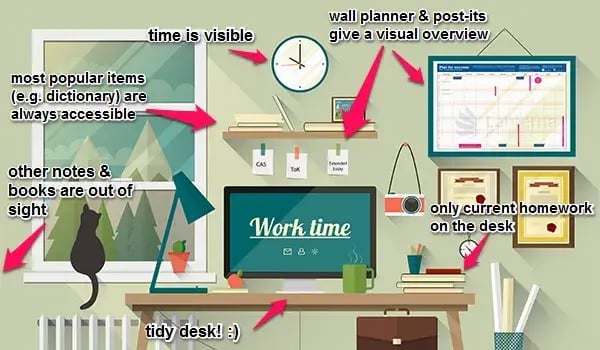
- Have a designated place where you keep each kind of work, and keep them separate: 1) homework. 2) notes to use later in revision. 3) rough work. Each category should be divided by subject and by topic – your notes on organic chemistry will be no use if they’re hidden away with your annotated Charles Dickens novels! To feel extra smug, label each work category, subject and topic. At the end of each day take the extra time to put your work where it needs to go.
- Clear out any useless stationary, sweet wrappers and rough notes (when you’re done with them). Your workspace should be tidy and only contain the things you need.
- As well as all your actual work keep some sort of overview visible at all times, whether it’s a wall planner, a calendar or a noticeboard.
Your Virtual Things: Phone and Apps
We’ve all been in that position where we download an app and instantly become convinced it’s going to fix everything in our life. Well just like with the real ‘things’, the key to organisation here is to select a few apps to use on a weekly, if not daily basis.
After you’ve chosen use these consistently to stay organised, but then (and here’s the killer) don’t keep your phone with you when you do your work! Seriously, put it somewhere else, even if that means giving it to someone else or throwing it to the bottom of a river (don’t do that).
- Purge your phone of duplicate apps – you only need one to-do list app and what’s the point in having 3 different calendars?
- Get rid of the distraction apps. Don’t worry, I’m not saying eliminate WhatsApp or Snapchat. I am saying get rid of Candy Crush, Temple Run, and the replica Pokémon Gameboy Game.
- Keep your most useful apps on the first page of your phone to keep you motivated, for example you might have Evernote, Dropbox, Todoist and Calendar. The ones that will tempt you away from work again and again (i.e. Facebook, iTunes, Instagram) should be somewhere else that’s out of the way.
Your Time: Planning and Deadlines
I’ve spoken about that thing called time management before and it really deserves a blog in itself, but for now I’ll give you a concrete piece of advice for actually staying on top of your time.
Everyone always says we should plan our work and create schedules and stick to it, but how do you know what to schedule if you don’t know how long something will take?
In the first place, the IBO has recommendations for how long certain parts of the Diploma should take. For example, they say that the Extended Essay should take approximately 40 hours of student work. But when it comes to those piece of work that are a bit more random, such as essay plans, language essays, etc., it’s harder to predict. Here is what you should do:
- Choose a piece of work that you get fairly regularly, such as an English essay, or a page of Chemistry questions.
- Next time you do an assignment, time yourself. Use the stopclock on your phone if you feel on top of your game. Or if you listen to music while you work, make a note of how many tracks you listen to. Remember to pause the music or the stopclock if any distractions come up that you can’t prevent. You should only keep track of the time you spend actually working.
- Use this time as your average for when you’re on top of your game. Next time you make a plan or a schedule for a similar piece of work, give yourself this amount of time to do it and try to stick to it.
Got it? Now get organised!

We’re the Lanterna Team — a group of 600+ IB expert tutors, ranging from 45/45 IB graduates to IB teachers with 30+ years of teaching and examiner experience.
For over 20 years, we’ve supported tens of thousands IB students worldwide with one clear focus: making high achievement feel more doable. Our team of experienced tutors have come together to combine their deep curriculum knowledge with practical strategies that are proven to work.
Whether you’re building strong foundations in DP1, pushing for a final stretch in DP2, or looking for clarity on what to prioritise, we’re here to help you study smarter, stay confident, and get results.
.png)
IB Organization System Guide
Master IB organization and conquer overwhelm! Get expert tips to manage EE & IA deadlines, prioritize tasks, and build a balanced study schedule without burnout.

IB Diploma Timeline
Master the IB Diploma's two-year journey with our complete timeline. Get key deadlines and guidance for the Extended Essay, TOK, IAs, and CAS from DP1 through final exams.
How to Get Organized for the IB Diploma
Master the demanding IB environment. Get essential tips and strategies on how to stay organized, manage your time, and set yourself up for success in the Diploma Programme.
IB Exam Day Checklist
IB Exam Day Checklist: Essential things to do and bring (sleep, breakfast, materials) to ensure a smooth, mishap-free testing experience.

IB University Application Checklist
Get your free IB University Application Checklist: a timeline of key tasks (research, personal statements, recommendations) aligned with your IB schedule.
Essential IB Mock Exam Checklist 2026
Master DP2 with this essential IB checklist! Covers IA status, week-by-week mock exam prep, past paper scheduling, and key TOK/EE milestones for students and parents.

IB Year 2 (DP2) Roadmap for Parents
IB Year 2 (DP2) Overview: A roadmap for parents covering IAs/EE completion, university applications, mock exams, and final exams. Anticipate key pressure points.

How to Create Your IB Revision Plan (Structured vs. Flexible)
Learn how to create your perfect IB revision plan. Choose between structured ('Operation IB') or flexible ('Easy Breezy') approaches and find expert revision tips.