Skip to content
Mastering TOK Essay Webinar

Mastering TOK Essay Webinar

6 min read | Lanterna Team | January 1, 2026

Master the IB TOK essay with insider advice on deconstructing prescribed titles and choosing real-life examples. Learn how to structure arguments for maximum impact.

Mastering the TOK Essay: An Expert's Blueprint for Top Marks

As an IB graduate and former examiner, I know the unique challenge and immense reward of the Theory of Knowledge (TOK) essay. It’s more than an academic exercise; it’s a chance to sharpen your critical thinking and explore profound questions about knowledge itself. Many students find it daunting, but trust me, with the right strategy, top marks are absolutely within your reach.

This guide, inspired by our exclusive Lanterna Education webinar, distills years of experience into actionable insights. Think of it as the insider knowledge you need to excel. Let's demystify the TOK essay and get you equipped for success.

Your Path to TOK Essay Mastery

This guide is designed to transform your approach, moving you from confusion to clarity and confidence. By the end, you will be able to:

  • Deconstruct Prescribed Titles (PTs) to formulate a precise and relevant response.
  • Craft Compelling Arguments with strong, well-supported claims and counter-claims.
  • Integrate Powerful Real-Life Examples (RLEs) that illuminate your arguments.
  • Structure for Clarity and Impact to guide your examiner through your logic.
  • Target Top Assessment Criteria by applying the key elements examiners look for.
  • Avoid Common Pitfalls that can hold back even the brightest students.

Part 1: Unpacking the Prescribed Title (PT)

Your journey to an outstanding TOK essay begins here. Don't just read the question; dissect it. Every single word matters.

1. Deconstruct Key Terms

Identify and define the core concepts in your chosen PT. For example, if a title asks about "objectivity in historical knowledge," your first job is to explain what "objectivity" and "historical knowledge" mean in the context of your essay. Acknowledge that these terms can be ambiguous—that’s a sign of sophisticated thinking.

2. Identify the Underlying Knowledge Question(s)

Every PT is a gateway to a deeper Knowledge Question (KQ). Your essay's purpose is to explore these KQs. A common mistake is treating the PT as a simple statement to agree or disagree with. Instead, ask yourself: "What is this PT really asking me about how we know what we know?"

3. Explore Scope and Limitations

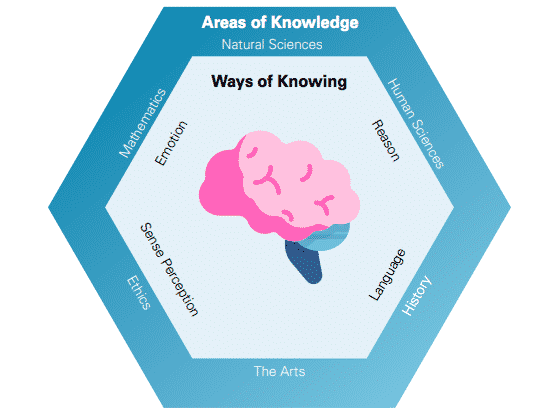
Set the boundaries for your essay. Which Areas of Knowledge (AOKs) are most relevant? You must discuss at least two. Acknowledging the limitations of your scope isn't a weakness; it's a critical strength.

Part 2: Crafting a Robust Argument

The TOK essay is not a descriptive report; it's an argument. You need to present a clear thesis, support it, and critically evaluate other perspectives.

Develop Claims

Each body paragraph should present a clear claim that directly addresses the PT. This is your primary point for that part of the essay, linked to one of your chosen AOKs.

Introduce Counter-Claims

This is crucial for top marks. After making a claim, you must explore a counter-claim. This shows intellectual balance and a deep engagement with the complexities of knowledge.

Justify Your Assertions

For every claim and counter-claim, you must provide justification. Explain how and why you've arrived at your position, drawing on your understanding of TOK concepts. Don't just state things; explain your reasoning.

Part 3: The Power of Real-Life Examples (RLEs)

RLEs are the lifeblood of your essay. They ground your abstract discussion in concrete reality, making your arguments far more compelling.

  • Relevance is Key: Your RLEs must directly illustrate your claims. Don't just mention a situation; analyze how it exemplifies a particular knowledge issue.
  • Depth Over Breadth: It’s better to have two or three well-developed RLEs than many superficial ones. Explain the context, the knowledge issue it highlights, and its implications for your argument.
  • Be Diverse: Draw from different AOKs, cultures, and historical periods. While personal experiences can work, they must be analyzed in a way that contributes to a broader discussion about knowledge.
  • Link Back Explicitly: After analyzing an RLE, always connect it back to the Knowledge Question and your main thesis. How does this example deepen our understanding?

Part 4: Structuring for Success

A well-structured essay is easy for the examiner to follow. Think of it as giving them a roadmap to your thinking.

The Anatomy of a Perfect Body Paragraph:
  1. Topic Sentence: Introduce your claim, linking it to the PT.
  2. Explanation: Elaborate on the claim using TOK concepts.
  3. Real-Life Example (RLE): Introduce and describe your RLE.
  4. Analysis: Critically analyze how the RLE supports your claim.
  5. Counter-Claim: Introduce a contrasting perspective or limitation.
  6. Analysis of Counter-Claim: Discuss its implications.
  7. Mini-Conclusion: Summarize the paragraph's point and link back to the overall thesis.

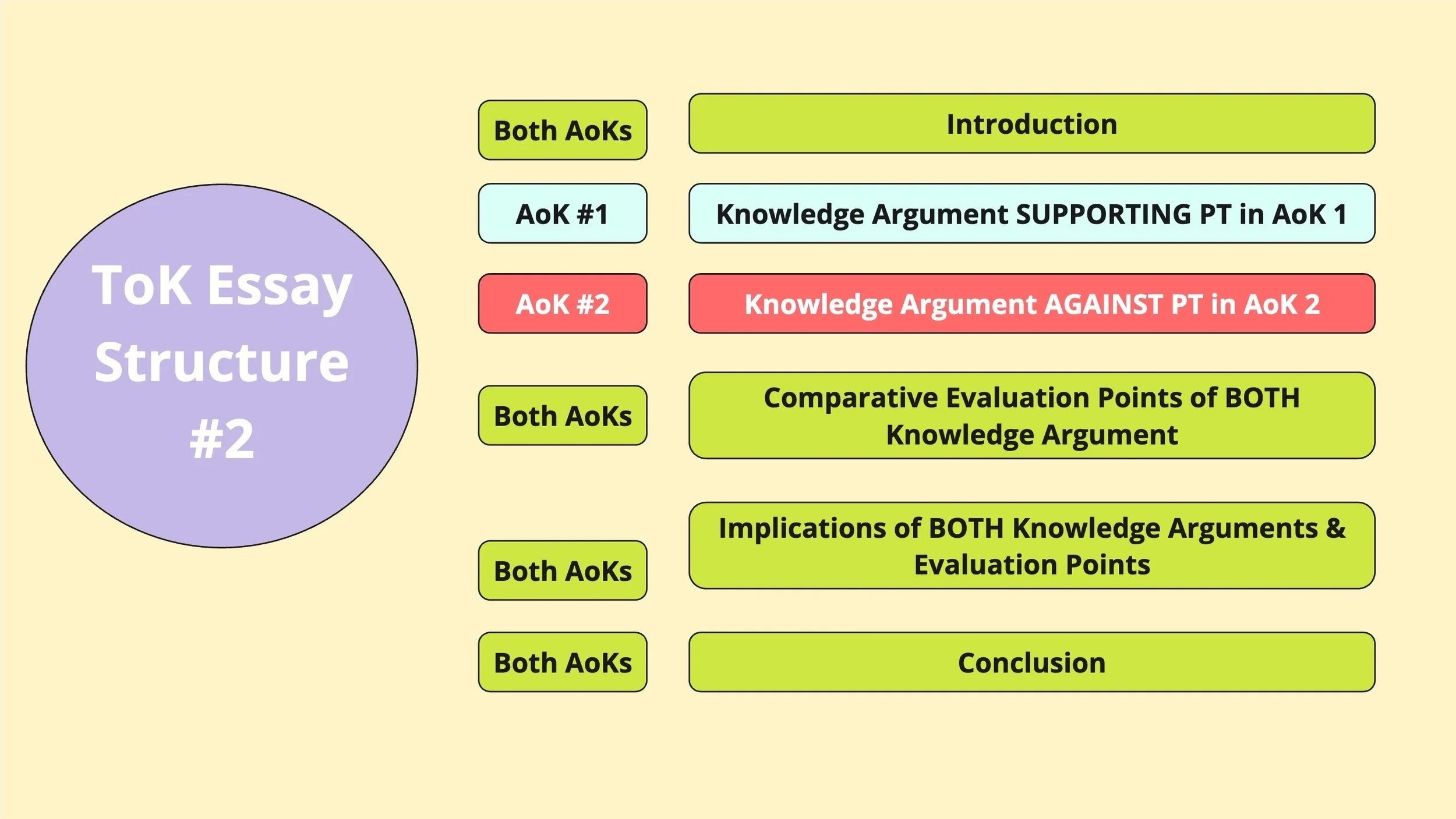
The Overall Essay Structure

Section Purpose & Content
Introduction State the PT, define key terms, present your thesis, and outline the AOKs you will explore. This is your roadmap.
Body Paragraph 1 (AOK 1) Develop your first claim and counter-claim, supported by a strong RLE, focusing on your first chosen AOK.
Body Paragraph 2 (AOK 2) Develop your second claim and counter-claim, supported by another strong RLE, focusing on your second AOK.
Conclusion Restate your thesis in a new light, summarize your main arguments, and offer a final, nuanced thought on the broader implications of your conclusion. Do not introduce new arguments here.

Part 5: What Examiners Are Really Looking For

To hit the top bands, you need to move beyond just "good" and demonstrate sophisticated engagement. Here's the checklist:

  • Consistent Focus on the PT: Every paragraph must clearly serve the purpose of answering the prescribed title.
  • Critical Thinking and Nuance: Show you understand the complexities and limitations of knowledge. Avoid black-and-white thinking.
  • Effective Use of RLEs: Your examples must be well-chosen, well-explained, and well-analyzed.
  • Coherence and Clarity: Your essay needs a logical flow and must be written in precise, academic language.
  • Independent Thought: The best essays show your unique voice and original insights, not just textbook definitions.

Common Pitfalls to Avoid

Even great students make these mistakes. Be the one who doesn't.

  • Being Descriptive, Not Analytical: This is the biggest trap. Don't just describe a theory or an event; analyze its significance to your argument.
  • Using Generic Examples: Avoid clichés (e.g., "Columbus thought the world was flat"). Find specific, interesting RLEs.
  • Ignoring the Counter-Argument: A one-sided essay is not a TOK essay. You must engage with alternative perspectives.
  • Misinterpreting the PT: Make sure you are answering the question exactly as it is written, not the question you wish it was.
  • Relying on Opinion: Your arguments must be grounded in reasoned justification, not just "I feel" or "I think."

Your Next Step to TOK Success

The TOK essay is your chance to shine intellectually. By dissecting your PT, building robust arguments with powerful RLEs, and structuring for impact, you are well on your way to an exceptional grade.

At Lanterna Education, we know every student's journey is unique. Our expert IB tutors specialize in providing personalized guidance that transforms understanding into top-tier performance. If you're looking for tailored support to master this pivotal component of the IB Diploma, our TOK specialists are here to help.

Lanterna Team
Lanterna Team
We’re the Lanterna Team — a group of 600+ IB expert tutors, ranging from 45/45 IB graduates to IB teachers with 30+ years of teaching and examiner experience.

For over 20 years, we’ve supported tens of thousands IB students worldwide with one clear focus: making high achievement feel more doable. Our team of experienced tutors have come together to combine their deep curriculum knowledge with practical strategies that are proven to work.

Whether you’re building strong foundations in DP1, pushing for a final stretch in DP2, or looking for clarity on what to prioritise, we’re here to help you study smarter, stay confident, and get results.

Why Lanterna?

Lanterna Education is the largest IB-focused education provider worldwide, supporting students in over 250 partner schools across 80+ countries. Based in Stockholm, we have over 20 years of experience helping IB students achieve the best possible score in the IB.
15,000+
IB students tutored
1.5+
Avg. IB Subject grade Increase
36/45
Median final IB score for students
4.7
Trustpilot score

The TOK essay is a crucial component of the IB Diploma, challenging you to explore the nature of knowledge through a prescribed title. It's vital because it tests your critical thinking, analytical skills, and ability to make connections across different Areas of Knowledge, contributing significantly to your overall IB points.

Selecting a PT requires careful thought. Choose one that genuinely interests you and for which you can identify relevant real-life examples and explore diverse perspectives across at least two Areas of Knowledge. Avoid titles that are too broad or too narrow for a nuanced discussion.

RLEs are specific, concrete situations that illustrate abstract knowledge claims. To use them effectively, ensure they are relevant to your argument, deeply analyzed (explaining how they demonstrate a knowledge issue), and varied across different contexts. Don't just describe; analyze their implications for knowledge.

A descriptive essay merely explains concepts or events. An analytical essay, which is what examiners seek, critically examines these concepts, explores underlying knowledge questions, presents claims and counter-claims, and unpacks the implications of different perspectives on knowledge. It's about why and how we know, not just what we know.

It's beneficial to start thinking about the TOK essay early in your DP2 year, as soon as the prescribed titles are released. This allows ample time for brainstorming, research, drafting, and refining. Early preparation reduces stress and allows for more thoughtful development of your arguments and examples.

Lanterna's expert TOK tutors, many of whom are A-scoring graduates and former examiners, provide personalised guidance. We help you deconstruct prescribed titles, refine your arguments, select and analyze powerful real-life examples, structure your essay for clarity, and understand exactly what examiners are looking for to achieve top marks.

Absolutely. Our tutors are continuously updated on the latest IB curriculum changes, assessment criteria, and examiner expectations for the TOK essay. They provide guidance that is current, accurate, and aligned with the most recent IB requirements, ensuring you receive the most relevant and effective support.

The Lanterna IB consultation is a free, no-obligation 20-30 minute session with one of our Student Success Experts. It's designed to help you understand your academic needs, identify areas for improvement, and discuss your goals for the IB Diploma.

Yes, the consultation is 100% free with no obligation to purchase tutoring. During the session, you'll speak with a Student Success Expert who will listen to your concerns, offer insights into your IB journey, and help you create a clear plan with priorities and next steps to improve your performance and confidence.

Our Student Success Experts are highly knowledgeable individuals with deep understanding of the IB Diploma. They can help students and parents navigate the challenges of the IB, including subjects like TOK. They provide a holistic perspective, helping you fit TOK into your broader academic strategy and explore how personalised tutoring can support your specific needs.

After your consultation, you'll have a clear understanding of your academic standing and a personalised action plan. If you choose to explore tutoring further, your Student Success Expert can match you with a suitable Lanterna tutor who specialises in TOK, but there is absolutely no pressure to proceed. The insights from the consultation are yours to keep.


More free resources

IB TOK Essay Structure Guide
TOKUltimate GuideStudy SkillsDP1DP2Students

IB TOK Essay Structure Guide

Master the IB TOK Essay structure with our complete guide. Get step-by-step outlines for your introduction, AOK paragraphs (claims/counterclaims), and conclusion to hit top markbands.

How to Structure Your IB TOK Essay Step-by-Step
TOKUltimate GuideStudy SkillsDP1DP2Students

How to Structure Your IB TOK Essay Step-by-Step

Learn how to structure your IB TOK Essay step-by-step with this expert guide. Understand how examiners think and increase your TOK essay grading score with clear format tips.

Master IB TOK Guide
TOKUltimate GuideIAsDP1DP2StudentsParents

Master IB TOK Guide

Master IB Theory of Knowledge (TOK) with our complete guide. Learn about the curriculum, areas of knowledge, and ace your TOK exhibition and essay with structure tips and examples.

How to Get a Top Grade in IB ToK
TOKUltimate GuideStudy SkillsDP1DP2Students

How to Get a Top Grade in IB ToK

Learn how to get a top grade in IB ToK with expert tips covering Shared/Personal Knowledge, Ways of Knowing, and Areas of Knowledge. Achieve those crucial core points!

TOK Essay: A Complete Guide to Acing the IB TOK Paper
TOKUltimate GuideStudy SkillsDP1DP2StudentsParents

TOK Essay: A Complete Guide to Acing the IB TOK Paper

Master the IB TOK Essay with this complete expert guide. Learn how to structure your paper, understand grading criteria, and use critical thinking skills to achieve your diploma.

How to Write Your IB TOK Essay: Tips
TOKStudy SkillsUltimate GuideDP1DP2Students

How to Write Your IB TOK Essay: Tips

Write your IB TOK Essay with confidence. Learn essential tips on choosing a title, understanding IB criteria, and structuring your argument for top marks.

TOK Essay: How to write the IB TOK Essay
TOKUltimate GuideStudy SkillsDP1DP2Students

TOK Essay: How to write the IB TOK Essay

Learn how to write the IB TOK Essay using expert tips on terminology (WOKs/AOKs) and structure. Master this challenging assignment with confidence.

Complete Guide to IB TOK Basics: Ways of Knowing
TOKUltimate GuideAbout IBPre-DPDP1Students

Complete Guide to IB TOK Basics: Ways of Knowing

Understand IB TOK Basics: Learn the core concepts of Theory of Knowledge, including the 8 Ways of Knowing and Areas of Knowledge, with expert tips for success in the IB.


Professional Support for the Final Push

For over 21 years, we at Lanterna have guided over 15,000 students to success in the IB. We have 500+ expert tutors that can support you in any subject.
 

GRADUATES

Scored 40+ in the IB and 7s in the subjects they teach
Best for: skill-building & relatable mentorship
 

TEACHERS

Certified educators with 10+ years’ IB experience
Best for: curriculum clarity & confidence building
 

EXAMINERS

Current or former IB examiners & senior markers
Best for: exam preparation & top-band results


BOOK A FREE CONSULTATION TODAY

Our student success experts give you personalised advice on how to best succeed in your journey.
100% Free · No obligation

Stockholm based, supporting students worldwide. We are IB experts committed to achieving your academic goals.

ABOUT US

Get In Touch

Sibyllegatan 47, Stockholm Sweden, 114 42

Contact us

ALL RIGHTS RESERVED. COPYRIGHT 2025. LANTERNA EDUCATION LTD, NOT AFFILIATED WITH THE IBO
WhatsApp