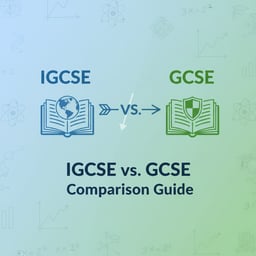
IGCSE vs. GCSE Comparison Guide
IB IGCSE vs. GCSE: What's the Difference? Find out what IGCSE means, why it's the "International" version, and how its university acceptance compares to clear up family confusion.
IGCSE vs. GCSE: Which is the Best Launchpad for the IB Diploma?
Choosing your path before the IB Diploma can be confusing. GCSE? IGCSE? What's the difference, and does it even matter for the IB? As IB experts, we get these questions all the time. Let's break it down, tutor-to-student, so you can make the best choice for your future.
This guide will help you:
- Understand the acronyms: Clearly define what GCSE and IGCSE are and their core purpose.
- Compare the key differences: See a side-by-side breakdown of curriculum, assessment style, and grading.
- Know what universities think: Clarify how top universities view each qualification.
- Get the insider take: Understand which qualification might better prepare you for the specific challenges of the IB.
The Basics: Defining Your Options
Before we compare them, let's get a clear picture of what each qualification is.
What is GCSE? The UK's Foundational Qualification
GCSE stands for General Certificate of Secondary Education. It's the main academic qualification for 14-16 year olds in England, Wales, and Northern Ireland. You'll study core subjects like English, Maths, and Science, plus several options you choose yourself. The GCSE is designed to give you a broad, solid education to prepare you for A-Levels or, of course, the IB Diploma.
What is IGCSE? The Global Standard
IGCSE stands for International General Certificate of Secondary Education. Think of it as the international version of the GCSE. While based on the British system, its content is designed for a global audience, avoiding a UK-centric focus. It's used in over 150 countries and is highly respected as a robust foundation for international programs like the IB.
The Head-to-Head Comparison: Key Distinctions
While similar, GCSEs and IGCSEs have some important differences in their structure and focus. Here's how they stack up:
| Feature | GCSE (General Certificate of Secondary Education) | IGCSE (International General Certificate of Secondary Education) |
|---|---|---|
| Primary Focus | Tailored for the education system within the UK. | Designed with an international audience in mind. |
| Curriculum Content | Often includes content specific to the UK national curriculum (e.g., UK-focused history or literature texts). | Broader, more international content, avoiding specific national biases to be relevant everywhere. |
| Assessment Style | A mix of coursework and final exams, though recent reforms have shifted the focus more towards exams. | Typically places a stronger emphasis on final examinations, with less (or no) coursework. |
| Grading System | In England, uses a numerical grading system from 9 (highest) to 1. | Traditionally uses an A* to G grading system, though some boards now offer the 9-1 scale as well. |
| Languages | Speaking components in modern language exams are usually a mandatory part of the assessment. | Some IGCSE language courses make the speaking test optional, which can be an advantage for non-native speakers. |
Do Universities and IB Schools Prefer One Over the Other?
This is the million-dollar question for many families. The short answer is: no, not really. Both GCSEs and IGCSEs are highly regarded and accepted by universities and IB schools worldwide as proof of a strong secondary education.
- For UK Universities: They see GCSEs and IGCSEs as equivalent. They care about the grades you get, not the title of the qualification. Getting a 9 in GCSE Maths is just as impressive as an A* or 9 in IGCSE Maths.
- For International Universities: The "International" in IGCSE can be a slight advantage, as it's a globally recognized brand. However, strong GCSE results are just as valued. The key is demonstrating a high level of academic achievement.
For entry into the IB Diploma Programme, schools look for the same thing: solid grades in a good range of subjects that show you're ready for the challenge ahead.
The Lanterna Verdict: Which is Better for IB Preparation?
So, which one gives you the edge for the IB? As IB graduates ourselves, we believe the "better" choice depends more on you than the qualification.
- The exam-heavy structure of the IGCSE is excellent practice for the final IB exams. It helps build the stamina and revision discipline you'll need in DP2.
- The broader, international curriculum of the IGCSE aligns nicely with the global perspectives of the IB, especially in subjects like History or Global Perspectives.
- However, the analytical rigour required for top grades in GCSEs is a perfect training ground for the critical thinking skills needed for TOK, the EE, and your Higher Level subjects.
Ultimately, both qualifications are robust launchpads. Your success in the IB will depend not on which one you took, but on the work ethic, curiosity, and resilience you developed along the way. At Lanterna Education, our expert tutors are here to help you build those skills and make a seamless transition into the IB Diploma Programme.

We’re the Lanterna Team — a group of 600+ IB expert tutors, ranging from 45/45 IB graduates to IB teachers with 30+ years of teaching and examiner experience.
For over 20 years, we’ve supported tens of thousands IB students worldwide with one clear focus: making high achievement feel more doable. Our team of experienced tutors have come together to combine their deep curriculum knowledge with practical strategies that are proven to work.
Whether you’re building strong foundations in DP1, pushing for a final stretch in DP2, or looking for clarity on what to prioritise, we’re here to help you study smarter, stay confident, and get results.
Why Lanterna?
While both are secondary education qualifications, IGCSE (International GCSE) is designed with a global perspective, often with more terminal exams and less coursework, making it popular in international schools. GCSE is primarily tailored for the UK national curriculum. Both are excellent foundations for the IB Diploma.
Both IGCSE and GCSE can provide a strong foundation for the IB Diploma. The "better" choice often depends on your school environment and future aspirations. IGCSE's international focus and exam-heavy assessment can sometimes align well with the IB's style, but strong grades and developed academic skills from either qualification are most crucial for IB success.
Yes, both qualifications are widely accepted by universities globally, including those in the UK, Europe, and North America. Universities primarily look at the strength of your grades and the breadth of subjects studied. For IB applicants, these qualifications demonstrate your readiness for rigorous academic study.
Ideally, discussions about pre-IB choices like IGCSE vs. GCSE should begin around Year 8 or 9 (age 13-14), as students prepare to select their subjects for the 14-16 age range. This allows ample time to understand the implications for their future IB and university pathways.
Our Student Success Experts, many of whom are IB graduates, offer free consultations to discuss your child's academic background, future aspirations, and how their current or chosen pre-IB path aligns with the IB Diploma. We provide clarity and a personalised plan to ensure a smooth transition.
The Lanterna IB consultation is a free, 20-30 minute session with one of our expert Student Success Experts. It's designed to help students and parents understand the IB Diploma, identify academic priorities, and develop a clear plan for success, whether that involves pre-IB choices, specific IB subjects, or overall strategy.
Yes, the consultation is absolutely free, with no obligation to purchase tutoring. Our goal is to provide valuable insights and a clear roadmap for your IB journey. We believe in empowering families with information first, helping you feel confident about your next steps.
Our Student Success Experts are experienced education professionals, often IB graduates themselves, who deeply understand the IB curriculum and its prerequisites. They can help you weigh the pros and cons of IGCSE vs. GCSE based on your child's learning style, academic goals, and desired university destinations, offering tailored, expert advice.
Absolutely. Many of our tutors are experienced in teaching IGCSE and GCSE subjects, understanding the specific curricula and assessment styles. We can provide targeted, personalised support to strengthen foundational knowledge and boost grades, ensuring students are well-prepared for the rigour of the IB Diploma Programme.
Strong grades in IGCSE/GCSE demonstrate a solid grasp of core subjects and effective study habits, which are crucial for the IB. They indicate readiness for the demanding academic workload, critical thinking, and independent learning required by the IB Diploma, setting a positive trajectory for higher achievement.
After your consultation, you'll have a clear understanding of your pre-IB options, a tailored study plan, and identified priorities. If you decide that personalised tutoring could benefit your child in their IGCSE/GCSE studies or IB preparation, our Student Success Experts can outline how Lanterna's expert tutors could provide that support, without any pressure.
More free resources
IB MYP vs GCSE Comparison Guide
IB MYP vs. GCSE: Is the Middle Years Programme right for your child? Our parent's guide explains the IB MYP curriculum, assessment, and comparison to the GCSE system.

Which IGCSE subjects should you choose? Here’s a guide!
Learn how to choose IGCSE subjects for the IB DP and university applications. Our guide offers expert advice on subject groups and keeping your options open.

How to Take Effective IB Notes: A Step-by-Step Guide
Learn how to take effective IB notes with expert tips on condensing information, sticking to essentials, and using your own words. Ace your IB revision and exams.

How to Master IGCSE Science: Expert Study Hacks
Mastering IGCSE Science is easier than you think. Learn expert study hacks and revision tips from tutors, understand exam formats, and focus on key concepts for top marks.

How to Prepare for IGCSE Success
Learn how to prepare for IGCSE success with expert advice on setting SMART goals, effective revision tips, and understanding the qualifications. Trusted by IB graduates.

Complete Guide to the IGCSE Test
Understand the IGCSE test: your complete guide to this qualification. Learn about key subjects, differences from GCSE, and how it paves the way for A-Levels and IB.

How to Choose IGCSEs: Complete Guide for IB Students
Learn why IGCSEs are a great choice for future IB students. Discover global university recognition, flexible courses, and skills that help you succeed worldwide.

How to Do Well on Your IGCSE Physics
Learn how to do well on your IGCSE Physics exam with expert revision tips. Discover practical ways to make real-world connections and improve your understanding.
Professional Support for the Final Push
GRADUATES
TEACHERS
EXAMINERS
BOOK A FREE CONSULTATION TODAY
Stockholm based, supporting students worldwide. We are IB experts committed to achieving your academic goals.
ABOUT US