-1.png?width=150&height=56&name=logotype_lanterna_education_blue%20(4)-1.png)

It’s no secret that the second year of the International Baccalaureate Diploma Programme (DP2) is crazy. Every IB student knows the course workload, subject groups and the IB’s three core elements are stressful, which is why managing that stress as well as keeping an eye on your Study-Life-Balance is so important.
Plus, if you make a point of learning how to overcome stressful situations during your last year in the IB Diploma programme, you’ll have those skills forever! And you can use them to cope with any stressful situations you encounter at school, in university and throughout your career.
So our tutors have some tips to share on managing stress that they used as students graduating from the IBDP. But first, we’ll explain how stress can help you, why stress management is crucial, and talk about the different types of stress IB students around the world experience.
Not All IB Student Stress Is Bad!
When you think of stress, you probably imagine sleepless nights, frustrated tears and feelings of panic that make breathing seem like the hardest thing in the world.
But the truth is, stress isn’t always bad; good stress exists, and it’s called eustress. IB Diploma students can use eustress to motivate themselves, improve concentration, and boost their performance during their second year of the programme.
Knowing a bit more about eustress and how it can help you complete your core requirements and the IB DP2, let’s talk about the ‘bad’ stresses IB students often experience.
Why Stress Management Is Important For International Baccalaureate Diploma Programme (IB) Students
Second-year IB Diploma programme students can use eustress to push themselves and excel. But if you don’t learn to manage bad stress (AKA distress), it has horrible side effects!
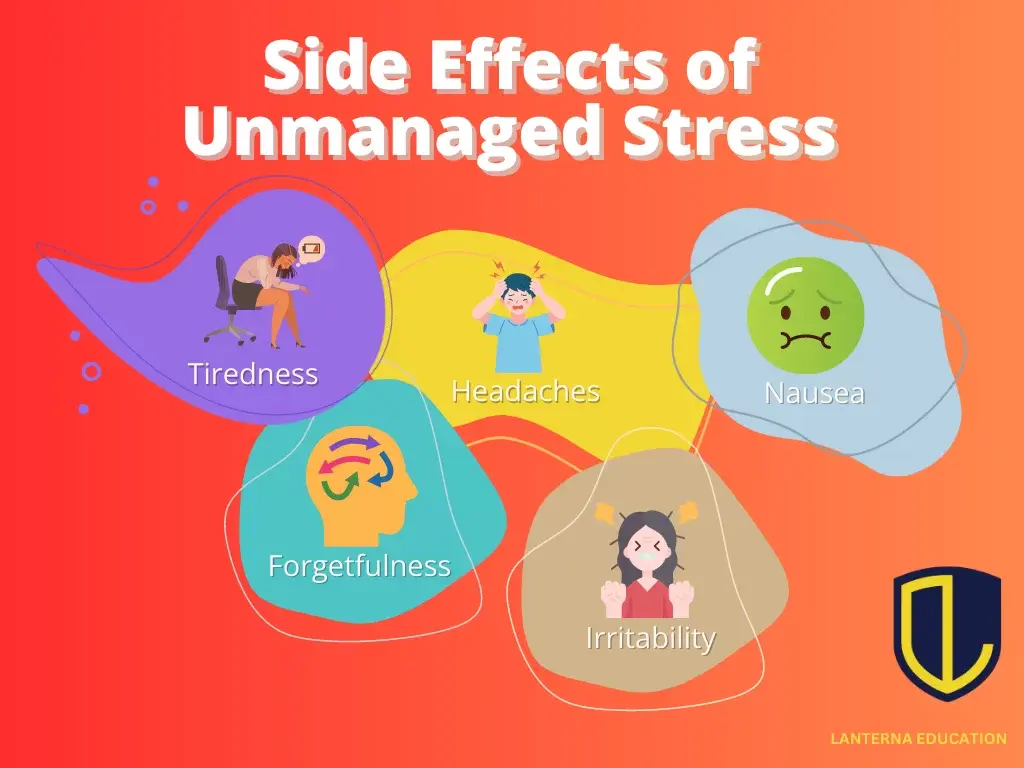
Learning to manage stress is vital because distress impacts us physically, mentally and emotionally, which prevents us from reaching our full potential. These are some of the side effects of unmanaged stress:
- Exhaustion and tiredness
- Insomnia and difficulty falling asleep
- Headaches and migraines
- Nausea and stomach problems
- Overeating or a loss of appetite
- Tense muscles and pain
- A weak immune system, which means you get sick often
- Struggling to concentrate and forgetfulness
- Irritability and difficulty controlling your emotions
- Feeling hopeless or like you’ve lost control
- Anxiety and depression
Types Of IB Student Stress
These are the most common stresses students need to manage during the IB Diploma programme:
1. Academic
Academics are one of the most obvious causes of IB stress. Students all over the world struggle to manage academic-related anxiety throughout the IB’s two-year programme.
Plus, the demands of the IB curriculum and the workload (for both standard-level subjects and higher-level subjects) can feel incredibly overwhelming.
IB Performance
Whether you consider yourself a perfectionist or not, the pressure to get these fantastic results can feel like the weight of the world on your shoulders! Academic performance is the biggest source of IB stress, and students often feel they must get that perfect score of 45 to impress higher education establishments and universities worldwide.
To help IB students improve their academic performance, our tutors put together a post with the best way to boost your DP2 scores. We hope it helps reduce some of your anxiety!
IB Diploma Exams
The pressure to study, recall facts and knowledge from various courses and master time management skills during examinations is another huge source of IB stress. In fact, IB exam stress can cause blackouts which affect your ability to achieve the results you need to get the IB Diploma or the grades needed to make the university application process easy.
It’s also important to remember that IB students don’t only need to manage IB stress brought on by subject groups, the Extended Essay (EE), and academic performance; learners in their second year of the IBDP often deal with other stressors too.
2. Personal
A student’s personal life can also interfere with their academic performance. Some students don’t have a peaceful, supportive home life or friends they can turn to, which impacts school life and IB programme results.
Social
When social pressures like parents’ expectations or struggling to fit in at school add to the stresses of learning different languages and taking additional sciences, focusing on school and meeting IB core requirements can feel like a mammoth task. Research into home environments and academic performance actually proves social pressures lead to students struggling mentally, emotionally and academically.
Financial
The IB programme offers many benefits, like helping develop students’ skills and introducing them to different languages and offering a greater body of knowledge. Plus, the two-year programme and Diploma certificate have university recognition worldwide! But, usually, schools offer the IB Diploma curricula as an opportunity for further academic study. So students pay additional IB school fees, which puts extra financial strain on families and IB students.
Health
Health problems aren’t just a symptom of unmanaged stress; they can cause it too. Anyone who’s missed an IB exam or assessment because of hospitalisation or a loved one fell seriously ill will tell you how stressful it is juggling health concerns and the IB programme’s curricula. Students expected to continue studying when a loved one is ill, or they feel sick find concentrating very challenging. It can leave IB students torn between prioritising a loved one’s or their own health and academic achievements.
Now that you understand how different types of stress can impact you, we will give you some pro tips on managing your IB stress during your second (and final!) year of the IB Diploma programme.
4 Pro Tips To Help Second-Year Students Manage IB Stress
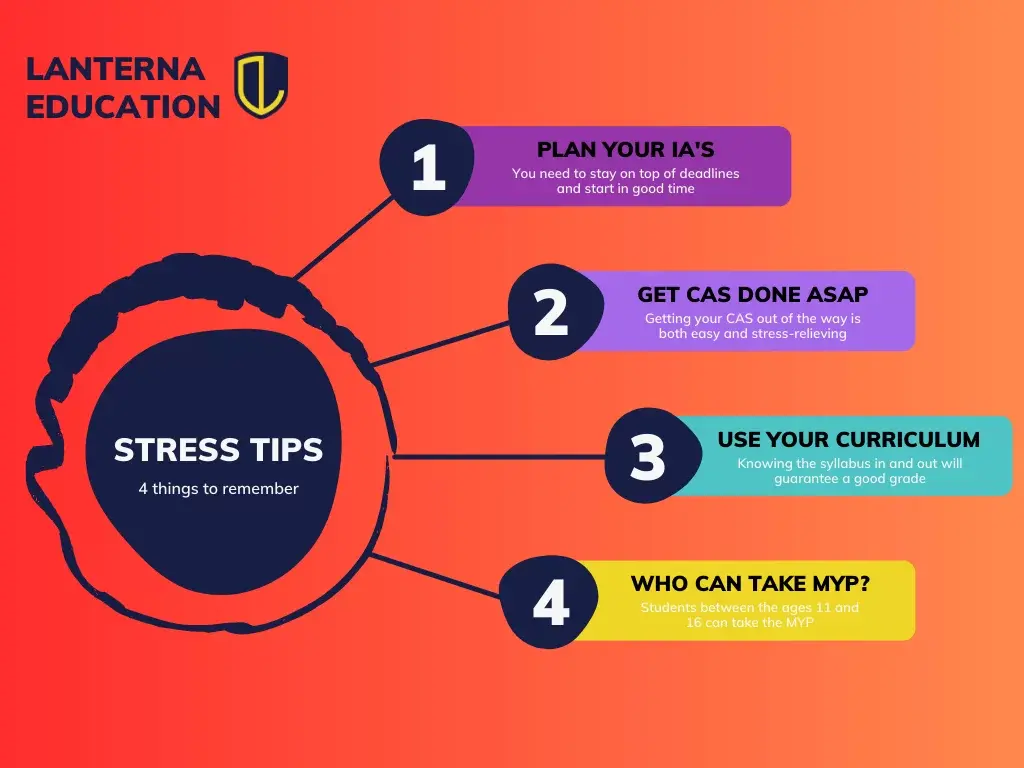
As IB graduates, the Lanterna Education tutors know how difficult the IB subject groups and course syllabus can be. And we’ve experienced the massive amounts of pressure higher level and standard level DP2 students go through to get their IBDP certificate. Which is why we want to help you succeed! Below, our team have put together our top 4 expert tips to help you finish the DP2 without turning into an anxious mess.
1) Plan Your Internal Assessments (IAs)
You know you’ll have to do between 3 and 5 IBDP Internal Assessments (IAs) for your 6 subject groups. So take some pressure off of yourself and start planning your IAs now!
If you plan ahead, find resources and do research now, answering your IA questions and writing IAs that meet all the core requirements for subjects like the Arts, Sciences and Language and Literature won’t send you into an absolute panic. Instead, planning ahead will help you feel in control and ready to give your best.
Need some advice on crafting a great IA essay? We’ve got the perfect post to help you! Read our top 5 tips for IAs here.
2) Do your IBDP Creativity, Activity, Service (CAS) first
As tutors, we see higher level and standard level students make the mistake of leaving their CAS assessment to the last minute (which makes the IB course even more stressful!) The best thing to do is to tackle your CAS first so you have the time and energy to concentrate on the rest of your coursework.
Plus, getting your CAS out of the way first means you give yourself more time to work on your written reflections and collect the evidence you need to submit to show that you’ve gained knowledge, developed new skills and done everything your CAS projects require!
Need help finding something to do for your CAS assignments? You’re in luck! We’ve got 50 CAS project ideas to inspire you, and a guide to help you get your CAS projects started now.
3) Use Your IB Curriculum
Did you know you can turn your IBDP curriculum into a stress-busting weapon? If you use your IBDP curriculum to plan your time, you can remove a lot of anxiety-inducing guesswork from your second year in the IBDP. And you can avoid spending time on one subject when you really should focus on another!
Your curriculum and grade descriptors are great tools that help you understand exactly what you must achieve in each subject. The DP2 curriculum is also a great way to ensure you meet every requirement for your IBDP core elements: Theory of Knowledge (TOK), Creativity, Action, Service (CAS) and the Extended Essay (EE).
Read this guide to learn how to use your IBDP syllabus and grade descriptors to reach your full potential during the last year of the IB Diploma programme.
4) Start Your Exam Revision Today
As we mentioned before, studying for your final IBDP examinations is a real stress inducer. And you never feel like you have enough time to cram all your subject knowledge into your head, right?
But there is a way to make studying easier and far less stressful! The answer is… Start studying now, and don’t stop!
If you make revision and study sessions part of your routine before exams start, you won’t feel the pressure of ‘digesting’ facts and important knowledge you’ll need to ace your mocks and finals.
Check out our post to help you study smarter, not harder. You’ll master revision long before it’s time to take your IBDP finals.

Manage IB Stress With Lanterna Education
Our team have loads of experience helping DP2 students taking standard-level subjects and higher-level subjects manage the stress of balancing school work and the IB Diploma programme’s core elements so they can earn their IB Diploma certificate.
Our experienced tutors offer one-on-one tutoring and personalised sessions to help IB students all over the world achieve the results they need to show admissions boards their true potential.
It’s our goal to help students graduating get into the schools, colleges and universities they’ve got their hearts and minds set on! This is why we also provide Free study skill resources and IB student tips, like guides to mastering the IB, mental health advice and more, to ensure you have everything you need to succeed today, tomorrow and in the future.

We’re the Lanterna Team — a group of 600+ IB expert tutors, ranging from 45/45 IB graduates to IB teachers with 30+ years of teaching and examiner experience.
For over 20 years, we’ve supported tens of thousands IB students worldwide with one clear focus: making high achievement feel more doable. Our team of experienced tutors have come together to combine their deep curriculum knowledge with practical strategies that are proven to work.
Whether you’re building strong foundations in DP1, pushing for a final stretch in DP2, or looking for clarity on what to prioritise, we’re here to help you study smarter, stay confident, and get results.
.png)
IB Stress Survival Guide
Beat IB stress and burnout with expert techniques. This guide covers time management, effective revision, and mindfulness habits to help you stay calm, focused, and ace your exams.

IB Stress & Burnout Survival Guide
IB Stress & Burnout Survival Guide: Essential habits and support for parents. Learn to recognize stress indicators (sleep changes, withdrawal) and find healthy coping strategies.

How to Cope with IB Exam Stress: Complete Guide
Cope with IB exam stress using expert tips for preparation, handling panic during the test, and post-exam reflection. Get practical advice and revision tips.

How to Manage Your IB Exam Stress: Practical Tips
Manage your IB exam stress with expert, practical tips. Learn how structured revision plans and self-care can help you conquer exam season anxiety.

Self-care & Mental Health Tips for IB Exams
Prioritize self-care and mental health during IB exams. Learn simple revision tips from an expert tutor to stay positive, motivated, and productive while studying.

How to Plan Your IB Revision Schedule & Avoid Burnout
Learn how to plan your IB revision schedule effectively and avoid study burnout with expert revision tips, including ideal daily study hours and flexible timetables.

How to De-Stress After IB Exams
Learn how to de-stress after IB exams and conquer the post-exam blues. Get expert tips on productive relaxation and understanding stress after the IB.

How to Get the Right IB Exam Mindset
Learn how to get the right IB exam mindset with expert revision tips covering effective study techniques, sleep, nutrition, and essential resources to boost your confidence.