-1.png?width=150&height=56&name=logotype_lanterna_education_blue%20(4)-1.png)
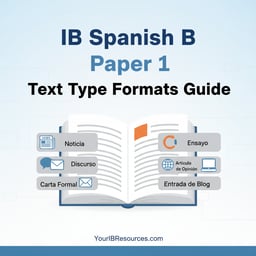
IB Spanish B Paper 1 Text Type Formats Guide
Master Spanish B Paper 1 writing! This reference sheet outlines formatting for common text types (Email, Blog, Article, Speech, Diary Entry), helping you ace "Conceptual Understanding" and secure top marks.
IB Spanish B Paper 1 Text Type Formats Guide: Your Blueprint for Success
Navigating IB Spanish B Paper 1 can feel like a linguistic maze, especially when it comes to mastering the nuances of different text types. At Lanterna, we know that understanding the specific conventions for emails, blogs, articles, speeches, and diary entries is not just about ticking boxes – it's about demonstrating authentic "Conceptual Understanding" and unlocking those top-tier marks. This guide distills the essential formatting and stylistic elements, offering you an insider's perspective on how to impress the examiners.
By using this guide, you will be able to:
- Identify the core characteristics and purpose of common IB Spanish B Paper 1 text types.
- Apply correct formatting conventions to emails, blogs, articles, speeches, and diary entries.
- Enhance your "Conceptual Understanding" by tailoring your writing to specific audiences and contexts.
- Strategize for maximum marks in Paper 1 by understanding examiner expectations.
Mastering Text Types: An Expert's Breakdown
Paper 1 of the IB Spanish B exam assesses your productive writing skills, requiring you to produce a written response of 250-400 words at Standard Level (SL) and 450-600 words at Higher Level (HL) based on one of three given prompts. Each prompt will be linked to a different text type and one of the five prescribed IB themes. Success hinges on your ability to demonstrate strong language command, clear communication of your message, and, critically, robust "Conceptual Understanding" – meaning your choice of text type, register, tone, and conventions are appropriate for the task's context, purpose, and audience.
Here’s how to ace the most common text types you might encounter:
1. Email (Correo Electrónico)
Emails in IB Spanish B can range from informal to formal, depending on the recipient and the context provided in the prompt.
- Purpose & Audience: To communicate directly with a person or organization. Could be a friend (informal) or a company/authority figure (formal).
- Key Formatting Elements:
- De: (From) – Sender's email address and name (fictional).
- Para: (To) – Recipient's email address and name (fictional).
- Asunto: (Subject) – A clear, concise, and relevant subject line in Spanish.
- Fecha: (Date) – Optional, but good practice (e.g., 8 de marzo de 2026).
- Saludo: (Salutation) – Informal: Querido/a [Name], Hola [Name]. Formal: Estimado/a Señor/a [Surname], Estimados Señores.
- Introducción: State the purpose of the email.
- Cuerpo: (Body) – Develop your ideas in clear paragraphs.
- Cierre: (Closing) – Informal: Escríbeme pronto. Formal: Quedo a la espera de su respuesta.
- Despedida: (Farewell) – Informal: Un abrazo, Besos. Formal: Atentamente, Cordialmente.
- Firma: (Signature) – Your fictional name.
- Tone & Register:
- Informal: Use tú forms, colloquial expressions, and a friendly tone.
- Formal: Use usted forms, polite and professional language, avoiding slang.
- Conceptual Understanding Tips: Ensure your choice of tú or usted is consistent and appropriate for the relationship between sender and receiver. The subject line should accurately reflect the email's content.
2. Blog Post (Entrada de Blog)
Blog posts are a common text type that allow for a more personal and engaging style of writing.
- Purpose & Audience: To share personal perspectives, opinions, experiences, or information with a (usually) broad, interested audience or specific peers.
- Key Formatting Elements:
- Título: (Title) – Catchy and engaging to grab reader attention.
- Fecha, Hora y Nombre de Usuario: (Date, Time, Username) – Essential for a blog.
- Introducción: An engaging opening, possibly with a rhetorical question, anecdote, or bold statement to hook the reader.
- Cuerpo: (Body) – Organized into paragraphs, often using subheadings. Can include personal examples or anecdotes.
- Interacción: Direct address to readers, rhetorical questions, and calls for comments are common.
- Conclusión: Summarize key ideas, offer a final thought, or ask a concluding question.
- Firma: (Signature/Author) – Your fictional name or a blog pseudonym.
- Tone & Register: Typically informal to semi-formal, personal, and engaging. Use tú or vosotros/ustedes forms to address readers.
- Conceptual Understanding Tips: Clearly define your audience in the opening sentences. Maintain a consistent, engaging tone. If discussing an issue, present both sides before offering your opinion.
3. Article (Artículo)
Articles in Paper 1 can be informative (objective) or opinion-based (subjective/persuasive), often for a school newspaper, magazine, or website.
- Purpose & Audience: To inform, explain, debate ideas, or persuade a targeted audience about a specific topic.
- Key Formatting Elements:
- Título: (Title) – Interesting and relevant to the article's content.
- Introducción: Briefly introduce the topic and what the article will cover.
- Cuerpo: (Body) – Two or three well-developed paragraphs. For informative articles, focus on facts; for opinion pieces, present arguments with supporting evidence.
- Conclusión: Summarize the main points and offer a final thought or call to action (for persuasive articles).
- Nombre del Autor: (Author's Name) – Preceded by "Escrito por:" or similar.
- Tone & Register:
- Informative: Objective, neutral, formal or semi-formal.
- Opinion: Subjective, persuasive, can be more engaging but should remain coherent and logical.
- Conceptual Understanding Tips: Distinguish clearly between objective information and personal opinion. Ensure the article's structure logically supports its purpose, whether it's to inform or persuade.
4. Speech (Discurso)
A speech requires you to write a script that is intended to be delivered orally, demanding careful consideration of audience engagement.
- Purpose & Audience: To communicate information, persuade, or inspire an audience (e.g., classmates, teachers, community members).
- Key Formatting Elements:
- Título: (Title) – A clear and impactful title for your speech.
- Saludo Inicial: (Opening Greeting) – Address your audience directly (e.g., Estimados compañeros y profesores, Buenos días a todos).
- Introducción: Hook the audience immediately (e.g., rhetorical question, surprising statistic) and clearly state your topic and purpose.
- Cuerpo: (Body) – Organize your ideas logically into distinct points, supported by evidence, examples, or personal anecdotes.
- Recursos Retóricos: (Rhetorical Devices) – Incorporate rhetorical questions, repetition, and direct address to engage the audience.
- Conclusión: Summarize key ideas, reiterate your main message, and end with a strong call to action or a memorable closing statement (e.g., ¡Muchas gracias por su atención!).
- Tone & Register: Semi-formal to informal, depending on the audience and context. It should be engaging, enthusiastic, and persuasive, but maintain clarity.
- Conceptual Understanding Tips: Remember it's an oral delivery. Use language that sounds natural when spoken. Consider how pauses and emphasis would work.
5. Diary Entry (Diario Personal)
Diary entries are highly personal and informal texts, offering a glimpse into one's thoughts and experiences.
- Purpose & Audience: To record personal thoughts, feelings, and events, primarily for oneself.
- Key Formatting Elements:
- Fecha y (opcionalmente) Hora/Lugar: (Date and optional Time/Place) – Essential for a diary entry (e.g., 8 de marzo de 2026, Lunes, por la noche).
- Saludo: (Salutation) – Typically Querido diario.
- Introducción: A short, informal sentence introducing what you will discuss.
- Cuerpo: (Body) – Informal, personal, and written in the first person (yo). Focus on feelings, reflections, and descriptions of events.
- Cierre/Despedida: (Closing/Farewell) – Informal closing remarks (e.g., Bueno, tengo sueño, Hasta mañana).
- Firma: (Signature) – Your fictional name.
- Tone & Register: Always informal and personal. Use tú forms if addressing the diary directly.
- Conceptual Understanding Tips: Ensure the entry is genuinely reflective and personal. Avoid overly formal language. The content should clearly align with the inner thoughts and experiences of the "author."
General Strategies for Paper 1 Success
Beyond specific text type formats, these overarching strategies will elevate your Paper 1 performance:
- Plan Before You Write: Dedicate 10-15 minutes to dissect the prompt. Highlight the context, audience, and purpose. Brainstorm ideas, key vocabulary, and create a basic outline to ensure a coherent and logical structure. This is crucial for meeting Criterion B (Message).
- Master Vocabulary and Grammar: Strive for fluency and accuracy. Use a varied and advanced vocabulary, incorporating idioms and complex sentence structures (e.g., conditional, subjunctive). Avoid repetition and minimize grammatical errors. This directly impacts Criterion A (Language).
- Mind Your Word Count: Adhere to the specified word count (SL: 250-400 words; HL: 450-600 words). While quality over quantity, writing close to the upper limit demonstrates a wider range of language and ideas.
- Embrace Fictional Details: When required to include names, addresses, or other personal details, always create fictional ones in Spanish. Never use your real personal information.
- Review and Refine: Always leave time to read over your response. Check for spelling, accents, verb conjugations, and adjective agreements. Ensure your ideas are clearly presented and flow smoothly.
By internalizing these text type formats and applying these expert strategies, you'll be well-equipped to tackle IB Spanish B Paper 1 with confidence and achieve the top marks you deserve. At Lanterna, we believe in empowering students with the insider knowledge that transforms potential into outstanding results. ¡Mucha suerte!

We’re the Lanterna Team — a group of 600+ IB expert tutors, ranging from 45/45 IB graduates to IB teachers with 30+ years of teaching and examiner experience.
For over 20 years, we’ve supported tens of thousands IB students worldwide with one clear focus: making high achievement feel more doable. Our team of experienced tutors have come together to combine their deep curriculum knowledge with practical strategies that are proven to work.
Whether you’re building strong foundations in DP1, pushing for a final stretch in DP2, or looking for clarity on what to prioritise, we’re here to help you study smarter, stay confident, and get results.
Why Lanterna?
Conceptual Understanding in Paper 1 means demonstrating that you fully grasp the purpose, audience, and context of the given text type. It's about more than just format; it's using appropriate register, tone, and stylistic conventions to communicate authentically. Examiners award top marks for responses that show this deep understanding, as it impacts clarity, coherence, and overall effectiveness.
Mastering text type formats is fundamental because it directly addresses the IB's assessment criteria for Criterion B (Message) and Criterion C (Conceptual Understanding). Correct formatting, tone, and register ensure your message is clear, appropriate for the audience, and shows you can adapt your writing to different contexts. It's how you demonstrate authentic communication in Spanish, which is key to unlocking higher bands.
Common mistakes include mixing formal and informal registers, incorrect salutations/closings, or failing to address the specific audience. To avoid these, always start by dissecting the prompt: identify the context, purpose, and audience. Plan your response carefully, outlining the key elements of the chosen text type, and double-check your formatting and tone during your review. Our guide provides specific tips for each text type to help you.
It's ideal to start familiarizing yourself with text types early in DP1, building a solid foundation. In DP2, you should be actively practicing writing different text types under timed conditions, focusing on refining your language and conceptual understanding. Consistent practice throughout the IB Diploma is key to feeling confident and prepared for the exam.
The Lanterna Free IB Consultation is a complimentary 20-30 minute session with one of our expert Student Success Experts. It's designed to help you clarify your IB goals, identify academic challenges, and discuss a clear plan for your success. There's absolutely no obligation to purchase tutoring afterwards; it's simply a valuable opportunity to get expert guidance and a personalised roadmap.
Our Student Success Experts are highly experienced IB graduates who understand the programme inside out. They can help you identify specific areas for improvement in Spanish B, like mastering Paper 1 text types, or developing overall study strategies. During your free consultation, they'll work with you to create a clear plan, prioritise your next steps, and ensure you feel confident moving forward.
Absolutely not. The Lanterna Free IB Consultation is a no-obligation session designed to provide you with clarity, a personalised plan, and expert advice for your IB journey. Our goal is to empower you with the knowledge and strategies you need to succeed, regardless of whether you choose to pursue tutoring with us.
Our Lanterna tutors are top-scoring IB graduates who specialise in Spanish B. They provide personalised 1-on-1 support, offering detailed feedback on your writing, helping you refine your text type formats, improve your vocabulary and grammar, and strengthen your "Conceptual Understanding." They teach you how to effectively plan your responses, manage your time, and apply advanced linguistic structures to impress examiners and achieve higher grades.
Yes, absolutely. During your free consultation, our Student Success Experts will discuss your current progress, identify your strengths and weaknesses in Spanish B, and help you map out a clear, personalised study plan. This plan will include strategies for mastering Paper 1 text types, improving all four language skills, and ensuring you're on track to meet your target grades. We tailor our approach to your individual needs and learning style.
Yes, Lanterna provides comprehensive support for all components of IB Spanish B, at both SL and HL. Our expert tutors can help you with Paper 2 (reading comprehension), Paper 3 (HL only, listening comprehension), the Individual Oral, and overall language acquisition. Whether you need help with grammar, vocabulary, speaking practice, or exam technique, our global team of tutors is ready to provide personalised, online assistance.
More free resources

Your Guide to the IB Language B Syllabus Changes
Your expert guide to the IB Language B syllabus and assessment. Learn the five key themes and get a clear breakdown of requirements for Paper 1, Paper 2, and the Oral IA.
How to Write a Commentary for IB Language and Literature Paper 1
Learn how to write a commentary for IB Language and Literature Paper 1 with an expert's 14-step guide. Master SL/HL assessment criteria and ace your IB exam.

How to Master IB Language B Learning Techniques
Master IB Language B learning techniques with top tips on reading, speaking, and listening from an IB expert. Achieve fluency and ace your language exams with effective study routines.
How to Learn a Second Language for the IB
Learn how to master your second language for the IB with expert revision tips covering vocabulary building, grammar practice, and listening skills using top resources like Memrise and Duolingo.

Mastering IB Command Terms: Your Ultimate Guide
Master your IB exams by understanding key command terms. Our expert guide provides a complete list of definitions for terms like 'analyze', 'discuss', and 'evaluate'.

How to Ace Your IB French B Oral Exam
Learn how to ace your IB French B oral exam with expert revision tips, including key grammar showcase strategies and the 3-layered analytical approach for success.

How to Structure Your IB TOK Essay Step-by-Step
Learn how to structure your IB TOK Essay step-by-step with this expert guide. Understand how examiners think and increase your TOK essay grading score with clear format tips.

How to choose: IB Literature vs. Language & Literature
Deciding between IB Literature and Language & Literature? Learn the exact differences in focus, texts studied, and assessment requirements for IB English A courses.
Professional Support for the Final Push
GRADUATES
TEACHERS
EXAMINERS
BOOK A FREE CONSULTATION TODAY
Stockholm based, supporting students worldwide. We are IB experts committed to achieving your academic goals.
ABOUT US