-1.png?width=150&height=56&name=logotype_lanterna_education_blue%20(4)-1.png)
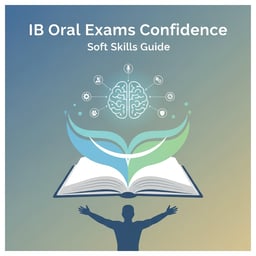
IB Oral Exams Confidence: Soft Skills Guide
Master your IB language oral exams with confidence! Get soft-skill tips for French, English, and Spanish orals, including body language, effective filler words, and strategies for handling tricky Q&A sections.
IB Oral Exams Confidence: The Soft Skills Guide
Navigating your IB language oral exams can feel daunting, but mastering the content is only half the battle. We know that true confidence in your French, English, or Spanish oral isn't just about perfect grammar; it's about how you present yourself, connect with the examiner, and manage the unexpected. This is the insider strategy that elevates a good performance to an outstanding one.
This guide is designed to empower you with the soft skills needed to excel. By focusing on practical, actionable techniques, you'll learn to project confidence, articulate your thoughts clearly, and navigate even the trickiest moments with poise.
By using this guide, you will be able to:
- Enhance your non-verbal communication: Master body language techniques that convey confidence and engagement.
- Optimize your vocal delivery: Learn to control your pace, tone, and clarity for maximum impact.
- Utilize effective linguistic tools: Discover how to employ strategic filler words and pauses in your target language to maintain fluency.
- Strategize for the Q&A section: Develop robust approaches for understanding, responding to, and even redirecting challenging questions.
- Cultivate a confident mindset: Implement pre-exam mental preparation techniques to reduce anxiety and boost performance.
1. The Power of Presence: Body Language That Speaks Volumes
Your body language can be your greatest ally or your biggest betrayer. Consciously controlling it sends powerful signals of confidence and preparedness.
Eye Contact: The Window to Engagement
Maintain consistent, natural eye contact with your examiner. This shows you're engaged, confident, and respectful. Avoid staring; aim for brief, steady gazes that show you're actively participating. This is a universal sign of confidence in French, English, and Spanish contexts.
Posture: Stand Tall, Sit Tall
Whether standing or sitting, maintain an upright, open posture. Shoulders back and head up communicates self-assurance. Slouching can inadvertently suggest you're disinterested or not confident, so sit up straight!
Gestures: Natural and Purposeful
Use hand gestures naturally to emphasize points, but avoid fidgeting or overly dramatic movements. Keep them controlled and aligned with your message. In many cultures, moderate gesturing is seen as a sign of liveliness and passion.
The Confident Smile
A genuine, relaxed smile (especially at the beginning and end) can instantly make you appear more approachable and confident. It also helps to ease your own nerves.
2. Your Voice as a Tool: Pacing, Tone, and Clarity
How you speak is just as important as what you say. Your vocal delivery can convey enthusiasm, certainty, and understanding.
Pacing: Not a Race, Not a Crawl
Speak at a moderate, steady pace. Rushing makes you sound nervous and is hard to understand, while speaking too slowly can suggest you're unsure. Practice speaking at a comfortable speed, allowing for natural pauses to let your points land.
Tone: Expressive and Engaging
Vary your tone to keep the examiner engaged. A monotone delivery is boring for the listener. Infuse your voice with appropriate emotion and conviction, whether you're discussing a literary text in English or a cultural topic in French.
Clarity and Pronunciation
Articulate your words clearly. Focus on good pronunciation in your target language. If you're unsure about a word, it's better to rephrase than to mumble. Remember, the goal is effective communication.
Volume: Be Heard, Not Shouted
Speak loudly enough to be easily heard without shouting. A confident voice is audible and steady. Adjust your volume to the room and the examiner's distance.
3. Strategic Pauses and Effective Filler Words
Relying on "um," "uh," and "like" can undermine your fluency. Learn to replace them with more effective strategies in your target language.
Embrace the Pause
A brief, deliberate pause can be incredibly powerful. It gives you a moment to gather your thoughts, emphasizes a point, and makes you sound considered rather than hesitant. Instead of filling silence with an "um," just take a second of silence.
Target Language Fillers (Used Sparingly)
In your target language, there are often culturally appropriate ways to buy time. For example:
- French: "Alors," "Donc," "Voyons voir..." (Let's see...).
- Spanish: "Pues," "Entonces," "A ver..." (Let's see...).
- English: "Well," "You know," "Let me think..."
Rephrasing for Time
If you're stuck, try rephrasing the question or your last point. This buys you a few seconds to formulate your next thought. For example, in Spanish: "Para clarificar, ¿está preguntando sobre...?" (To clarify, are you asking about...?).
4. Conquering the Q&A Section with Confidence
The Q&A can be the most unpredictable part of the oral exam. Here's how to master it.
Active Listening is Key
Pay close attention to the examiner's questions. Don't jump to conclusions. If you're unsure, it's always better to ask for clarification than to guess and go off-topic.
Clarify, Don't Guess
If a question is unclear, politely ask the examiner to repeat or rephrase it. This shows you're engaged and committed to providing an accurate answer. For example:
- French: "Pourriez-vous répéter la question, s'il vous plaît ?"
- Spanish: "¿Podría repetir la pregunta, por favor?"
- English: "Could you please repeat the question?"
Buy Yourself Time (Strategically)
Before diving into an answer, you can use a brief introductory phrase to collect your thoughts. For example:
- French: "C'est une bonne question..." (That's a good question...).
- Spanish: "Es una pregunta interesante..." (That's an interesting question...).
- English: "That's an insightful question..."
Structure Your Answers
Even under pressure, try to give structured answers. A simple "point, explanation, example" framework is very effective. This demonstrates clear thinking and organization.
It's Okay Not to Know Everything
You're not expected to be an encyclopedia. If you genuinely don't know the answer, be honest but pivot to what you do know. For example, in English: "I'm not entirely familiar with that specific detail, but I can tell you about the related theme of..." This shows integrity and the ability to adapt, which is a high-level skill.
5. Pre-Exam Mental Prep: Building Inner Confidence
Confidence isn't just external; it starts from within. Don't neglect your mindset leading up to the exam.
Positive Visualization
Before the exam, close your eyes and vividly imagine yourself performing well. See yourself speaking fluently, maintaining eye contact, and answering questions clearly. This mental rehearsal can significantly reduce anxiety and build self-belief.
Mindfulness and Deep Breathing
If you feel nervous, practice deep breathing exercises. Inhale slowly for four counts, hold for four, and exhale slowly for six. This simple technique helps regulate your heart rate and clears your mind, allowing you to focus.
Positive Affirmations
Remind yourself of your preparation and abilities. Simple phrases like "I am prepared," "I can do this," and "I will communicate clearly" can help replace negative self-talk with empowering statements.
Your Path to Oral Exam Success
Excelling in your IB language oral exams goes beyond rote memorization. By consciously developing these soft skills – from your body language and vocal delivery to your strategic approach to questions – you'll not only enhance your performance but also gain invaluable communication skills for life beyond the IB.
At Lanterna Education, we believe in empowering students with every tool they need to succeed. Our expert tutors, all top IB graduates, offer personalized guidance, helping you refine these soft skills and more, ensuring you walk into your oral exam not just prepared, but truly confident.

We’re the Lanterna Team — a group of 600+ IB expert tutors, ranging from 45/45 IB graduates to IB teachers with 30+ years of teaching and examiner experience.
For over 20 years, we’ve supported tens of thousands IB students worldwide with one clear focus: making high achievement feel more doable. Our team of experienced tutors have come together to combine their deep curriculum knowledge with practical strategies that are proven to work.
Whether you’re building strong foundations in DP1, pushing for a final stretch in DP2, or looking for clarity on what to prioritise, we’re here to help you study smarter, stay confident, and get results.
Why Lanterna?
Soft skills for IB oral exams are non-linguistic abilities that enhance your performance, such as confident body language (eye contact, posture), effective vocal delivery (pacing, tone, clarity), strategic use of pauses, and techniques for handling Q&A sections with poise. They complement your linguistic knowledge to create a strong overall impression.
While grammar and vocabulary are crucial, soft skills significantly impact how your message is received. They convey confidence, engagement, and clarity, allowing examiners to better understand and appreciate your linguistic abilities. Mastering them can elevate your performance from good to outstanding, contributing to a higher mark in communication and interaction criteria.
Absolutely. The principles of confident body language, clear vocal delivery, strategic pausing, and effective Q&A techniques are universal. Whether you're taking French B SL, Spanish ab initio, or English A Literature HL, applying these soft skills will enhance your communication and presentation, regardless of the specific language.
Our expert tutors, all high-achieving IB graduates, provide personalised coaching. They can conduct mock oral exams, offer constructive feedback on your body language, vocal delivery, and Q&A strategies, and help you practice using target-language fillers and clarification phrases effectively. We help you build both linguistic and presentational confidence for your IB oral exams.
Yes, Lanterna provides expert tutoring for a wide range of IB language subjects at both Standard Level (SL) and Higher Level (HL), including English A/B, French A/B/ab initio, Spanish A/B/ab initio, and many others. Our tutors are specialists in their respective languages and the IB curriculum, ready to provide tailored support.
Yes, absolutely. While this guide focuses on soft skills, Lanterna's core strength is comprehensive IB tutoring. Our language tutors are experts in grammar, vocabulary, text analysis, and cultural context for all major IB languages, ensuring you're strong in both the 'what' and the 'how' of your oral exam. We can help you master every aspect.
The Lanterna IB consultation is a free, 20-30 minute session with one of our experienced Student Success Experts. It's designed to help you and your parents identify your current challenges, set clear goals for your IB journey, and create a personalised plan to achieve them, whether it's for oral exams, IAs, or overall academic strategy.
Yes, absolutely. The Lanterna IB consultation is completely free of charge, with no hidden costs or obligation to purchase tutoring afterwards. Our goal is to provide valuable guidance and support to IB students and parents, helping them navigate the program with clarity and confidence.
Our Student Success Experts are highly knowledgeable individuals with deep experience in the IB Diploma Programme. Many are former IB graduates themselves, trained to understand the specific challenges students face. They act as mentors, guiding you through academic planning and connecting you with the right resources, including our expert tutors if you choose.
During the consultation, you'll discuss your specific needs regarding your IB studies, such as preparing for oral exams, managing workload, or improving grades. Your Student Success Expert will listen, offer insights, and collaboratively develop a clear action plan with priorities and next steps tailored to your unique situation, helping you feel prepared and in control.
It's completely normal to feel nervous! This guide provides strategies like positive visualization, deep breathing, and positive affirmations to manage pre-exam anxiety. During the exam, remember to use strategic pauses to collect your thoughts, ask for clarification if needed, and rely on your practiced body language to project calm, even if you don't feel it internally. Our tutors can also help you develop personalized coping mechanisms and practice under pressure.
More free resources

How to Ace Your IB French B Oral Exam
Learn how to ace your IB French B oral exam with expert revision tips, including key grammar showcase strategies and the 3-layered analytical approach for success.

How to Smash Your IB English IO
Understand how examiners think and learn expert IB English IO revision tips, including grading criteria and structure, to smash your oral presentation.
Mastering IB Command Terms: Your Ultimate Guide
Master your IB exams by understanding key command terms. Our expert guide provides a complete list of definitions for terms like 'analyze', 'discuss', and 'evaluate'.

IB Exam Command Terms, with Examples
Mastering IB Exam Command Terms is key to high marks. Understand how examiners think with expert revision tips and examples for "Compare," "Describe," "Explain," and "Evaluate."
IB Exam Day Checklist
IB Exam Day Checklist: Essential things to do and bring (sleep, breakfast, materials) to ensure a smooth, mishap-free testing experience.
.png)
IB Stress Survival Guide
Beat IB stress and burnout with expert techniques. This guide covers time management, effective revision, and mindfulness habits to help you stay calm, focused, and ace your exams.

How to Get the Right IB Exam Mindset
Learn how to get the right IB exam mindset with expert revision tips covering effective study techniques, sleep, nutrition, and essential resources to boost your confidence.

How to Prepare for IB Exams: Top Tips & Strategies
Learn how to prepare for IB exams with proven strategies and revision tips from an IB graduate. Master planning, self-care, and effective study methods.
Professional Support for the Final Push
GRADUATES
TEACHERS
EXAMINERS
BOOK A FREE CONSULTATION TODAY
Stockholm based, supporting students worldwide. We are IB experts committed to achieving your academic goals.
ABOUT US