The Art of Effective Note-Taking for IB Success
The art of note-taking, or at least of taking effective notes, is often underestimated. While almost all of us make them in lessons, it’s easy to forget how valuable they can be later on. Making awesome notes in the IB is especially important, as there is so much information across the 6 subjects that needs to be retained for the exams.
However, it doesn’t matter what you’re studying – awesome note-taking will always be an efficient way of studying! Good notes aren’t just about taking in information as you go along, but a way to save time, effort and frustration (“what was that thing my teacher said I’d have to remember for one of the exams again?”) in the long-term.
With the Winter break approaching, it can be really helpful to think about how you can make your notes actually useful. How will the notes you make in class and at home during the last couple weeks of term look in January when you return to school? Equally, this is the perfect time to sit in front of a good seasonal film and make some awesomely attractive notes, whether for mocks or for later on!
This post will break down note-taking into two sections: content and form. And to quote the master composer and lyricist Stephen Sondheim:
"Content dictates form."
So on that ‘note’, let’s talk about content first.
Content
Use Your Own Words
Don’t just copy what the teacher or textbook says. I know it’s tempting, first of all because it’s easier, but also because you might feel like you’ll never be able to phrase a point quite as perfectly. But seriously, you will understand and remember the information so much more easily if you write it in your own words. Think of your notes as messages to yourself in the future, so think about how you would explain it to make sure you actually understand it.
Stick with the Essentials
The whole point of notes is to preserve the information that you will find useful later. Don’t write down everything. Just write the key points that you can imagine yourself actually using later. For Mathematics and Sciences, these will include facts, formulae, and methods. For Literature and Social Sciences, facts, ideas, quotes. For Languages: vocabulary and grammar.
For those last subjects especially (literature, social science and languages) it’s also okay to choose what you consider to be the essential information, and you’ll save yourself time later if you do this as you go along. Rank the information from 1 to 3 according to how important or useful you consider it to be. Then when you come to revision, learn it in that order.
Keep them Brief
When it comes to notes, less is more. Make sure you have enough so that you actually understand what you were writing about later, but don’t write so much that it just looks like a block of scrawl by the end of the session. Keywords, facts and formulas are the most important. Stick to short, simple sentences and phrases that you can easily remember. This isn’t an essay.
Make them Personal
This is different from my point about using your own words. What I mean by this is remember that they are for you. If you don’t understand a word you’re writing down, make a note or mark in the margin to point out that you’ll probably have to go back to the topic later. Think about how you can write notes about your own notes (Ooh, meta…). For example “personally I think that David Copperfield is a flawed and one-dimensional character”.
You might want to think about dividing up the page before you start so you can break up your thoughts, like in the Cornell System.
Form
Classic Notes on Paper
Ideal for: Mathematics, Natural Sciences
I’m talking about what most of you probably imagine when you hear the word ‘notes’. Basic lined paper with the points written down in order of how you learned them. A few tips to keep in mind:
- Be as neat as you can. Please. Even if it takes you twice as long as notes using your typical messy writing, they will be twice as easy to read when you are going over them later.
- Embrace the space. Double-space the notes if you can, or if you are conscious of wasting paper then leave at least a line between each section. Make them as pleasant as possible to read later.
- Use highlighters to colour code the information.
- Use codes to indicate how you want to treat the notes later, e.g. an asterisk next to any points you think are particularly important*, or a question mark to indicate that you want to look at it again later?
Digital Notes
Ideal for: Literature, Social Sciences
As much as I like to recommend physical notes that you can hold and touch rather than whatever programme is on your laptop, I know that digital notes are the simplest option for most of us. I’m not going to tell you how to make these (you don’t need me to do that!), but the same rules apply as for classic notes: think about how they look. Format your notes as if you had to print it out to give to your teacher. And when it gets to the stage of actually revising those notes, make sure you print them out! They will be so much more effective than reading them off a screen.
Useful programmes for these aside from Word include Evernote and Simplenote, both free!
Visual Diagrams
Ideal for: Literature, Social Sciences, Natural Sciences
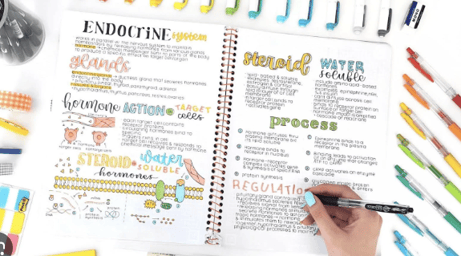
Spider diagrams, mind maps, or whatever you want to call them, are the perfect option if you know you’ll never remember simple notes on lined paper. Instead, they work by letting us associate ideas and information visually. Start with the key topic in the centre, and work outwards by connecting the facts and topic areas most closely associated with the word. The key to making these work is to:
- Actually compress each idea into minimal words. This isn’t about writing mini essays on different parts of the page.
- Make them look nice. The point of these is to aid visual learning, so they won’t work if they’re ugly to look at.
- Think about new connections and associations as you go. You should feel creative as you make them, so that you are making new connections as you go.
You can read this article here on how to create a mind map, and also to download a programme that will let you create one online.
Flashcards
Ideal for: Languages, Natural Sciences, Social Sciences
If any of you ever handwrite Christmas cards (now there’s a dying art form), or if your parents write them, make flashcards the same way as those; with snacks at the ready and music playing. They’re a great way to compress topics into just a few bullet points or summaries. They’re also perfect for travelling if you want simple notes to go through during your journeys to and from school later in the year. You could even write them on Christmas cards – they will be pretty, colourful, and more useful in the long-term!
The Wall
Ideal for: Literature, Languages
What do I mean by the wall? I mean post-it notes everywhere. Use different coloured paper or pens, write in big, clear letters. This is perfect if you want to surround yourself with the information, and ideal for memorising individual words or quotes. N.B. this method is not for the weak! Only for those of you who feel up to immersing yourselves in your subject, and probably recommended only if you’re revising for exams.
The Notebook
Not that one!
Ideal for: Everything
If you like having all your topics in one compact place, this is perfect for keeping track of all your subjects and also making your notes consistent. Like flashcards, these are great for being able to travel with you. However, do make sure you that remain concise with this one! Just because you have all that paper at your disposal does not mean you need to fill it. Keep your notes to the bare minimum so you don’t end up writing The Odyssey. And do use dividers or coloured indicators between the pages so you can easily flick between subjects. Better yet, leave the first few pages at the front free so you can create an index!
-1.png?width=150&height=56&name=logotype_lanterna_education_blue%20(4)-1.png)

.png)