-1.png?width=150&height=56&name=logotype_lanterna_education_blue%20(4)-1.png)
Mastering Your IB History IA: The Ultimate Guide
Master your IB History IA with our expert guide. Learn the structure, assessment criteria, how to find primary sources, and explore 50+ unique topic examples.
Mastering Your IB History IA: The Ultimate Guide
The History Internal Assessment can feel like the biggest challenge of your IB journey. It's an independent historical investigation, worth 20% of your final grade at HL and 25% at SL. But let’s reframe that: this is your chance to be a real historian. You get to choose a topic you're passionate about, dive deep into the evidence, and craft your own argument. This guide will walk you through every step, from picking a killer topic to polishing your final draft.
Deconstructing the IA: The Three Core Sections
Your 2,200-word investigation is broken down into three distinct parts. Think of them as building blocks for your historical argument.
Part 1: Identification and Evaluation of Sources (500 words)
This is where you set the stage. You'll state your focused research question and then conduct a detailed analysis of two key sources you'll be using. For each source, you need to explain its relevance to your question and critically evaluate its origin, purpose, value, and limitations (we'll cover the OPVL method later!).
Part 2: The Investigation (1,300 words)
This is the main event—the body of your essay. Here, you'll present your argument, supported by evidence from a wide range of primary and secondary sources. The key here is critical analysis. You're not just telling a story; you're evaluating evidence, considering different historical perspectives, and building a case that directly answers your research question.
Part 3: The Reflection (400 words)
Time to step back and think like a historian. In this section, you reflect on the process. What challenges did you face? How did your understanding of historical methods change? You need to connect your personal experience with the investigation to broader questions about the nature of history itself, like the reliability of sources or the role of the historian's perspective.
How Your IA is Marked: The Assessment Criteria
Understanding the mark scheme is like having the rules of the game. Your IA is graded out of 25 marks, split into three criteria:
- Criterion A: Identification and Evaluation of Sources (6 marks): Assesses the clarity of your research question and the depth of your analysis of the two key sources.
- Criterion B: Investigation (15 marks): This is the big one. It evaluates the quality of your research, the strength of your argument, your critical use of evidence, and your consideration of different perspectives.
- Criterion C: Reflection (4 marks): Assesses how thoughtfully you reflect on the methods you used and the challenges historians face.
The Most Important Step: Nailing Your Research Question
A great IA starts with a great question. A question that is too broad will lead to a descriptive, shallow essay. A question that is focused, specific, and debatable is the foundation for a high-scoring IA.
Follow this three-step process to narrow down your topic:
- Start Broad: Pick a topic or period that genuinely interests you. The Russian Revolution? The Civil Rights Movement? The Meiji Restoration? Your passion will fuel you through the research process.
- Add Scope Limitations: Now, get specific.
- Time Frame: Limit your focus to a few years, or even a few months. Instead of "The Russian Revolution," think "The period between February and October 1917."
- Geography: Focus on a specific country, region, or city. Instead of "The Civil Rights Movement," focus on "The desegregation campaigns in Birmingham, Alabama."
- Theme: Pinpoint a specific aspect, group, or policy. Instead of "The Meiji Restoration," focus on "The impact of educational reforms on the samurai class."
- Make it Analytical: Your question must invite debate, not a simple description of events. Frame it as an evaluation.
Example: From Broad Idea to Focused Question
- Broad Topic: World War II
- Narrowed Topic: Naval warfare in the Pacific during WWII.
- Specific Focus: American code-breaking at the Battle of Midway.
- Final Analytical Question: "To what extent did American code-breaking efforts influence the outcome of the Battle of Midway in 1942?"
Finding & Evaluating Sources: The OPVL Method
Primary sources are the raw materials of history—letters, diaries, government reports, photographs, speeches, and newspaper articles from the time. You need them to build your argument. You'll find them in online archives (like the Library of Congress), university digital collections, and databases like JSTOR.
To evaluate your sources like a top historian, use the OPVL method for your two chosen sources in Part 1:
| Component | What to Ask |
|---|---|
| Origin | Who created it? When and where was it created? Is it a primary or secondary source? |
| Purpose | Why was this source created? Who was the intended audience? What was it trying to achieve (e.g., inform, persuade, document)? |
| Value | Based on its origin and purpose, what makes this source valuable to your specific investigation? What insights does it provide? |
| Limitation | Based on its origin and purpose, what are the source's limitations? What perspectives does it ignore? What biases might be present? How does this affect its reliability for your question? |
Common IA Pitfalls & How to Avoid Them
- The Mistake: Writing a narrative. Many students just describe what happened.
- The Fix: Constantly analyze. For every piece of evidence you present, ask yourself, "So what? How does this prove my point and answer the research question?"
- The Mistake: Weak source evaluation. Simply stating a source is "biased" isn't enough.
- The Fix: Be specific. Explain how and why the source's origin and purpose create specific values and limitations for answering your question.
- The Mistake: Relying only on a few secondary sources.
- The Fix: Dig deep for a variety of primary and secondary sources. Show the examiner you've done comprehensive research and considered different historians' interpretations.
25 Focused IA Topic Ideas to Get You Started
Stuck for an idea? Use these focused research questions as inspiration. Notice how they all have a clear time, place, and theme.
Early Modern & 19th Century History
- How effectively did the public rituals surrounding the French monarchy during the Wars of Religion (c. 1562-1598) maintain royal authority?
- To what extent did the rise of photography challenge traditional painted portraiture as a symbol of status in Britain between 1840 and 1870?
- To what extent was Otto von Bismarck's foreign policy between 1871 and 1890 responsible for maintaining peace in Europe?
- How effectively did the Meiji government's compulsory education reforms (c. 1872-1890) achieve its goal of national unity in Japan?
- To what extent did the Spiritualist movement provide a platform for American women advocating for social rights between 1850 and 1880?
The 20th Century: Cold War & Beyond
- To what extent did the anxieties of nuclear conflict influence American science fiction literature between 1950 and 1965?
- Evaluate the impact of the launch of Sputnik (1957) on educational reforms in the United States up to 1965.
- To what extent was India's non-alignment policy a genuine expression of neutrality during the early Cold War (1947-1965)?
- How did the Tet Offensive in 1968 impact public opinion on the Vietnam War within the United States?
- Evaluate the effectiveness of psychological warfare by the CIA in undermining communist influence in Guatemala during the 1954 coup.
Asia, Africa, and the Middle East
- To what extent did Japanese assimilation policies during the colonial occupation of Korea (1935–1945) suppress Korean societal dynamics?
- How significant was the role of women in the Indonesian National Revolution (1945-1949) beyond traditional support roles?
- To what extent was foreign involvement responsible for prolonging the Angolan Civil War between 1975 and 1990?
- Evaluate the importance of religious factors in causing the outbreak of the Lebanese Civil War in 1975.
- How did the discovery of oil in Saudi Arabia (1930s-1970s) redefine its relationship with the global economy?
Latin American History
- Evaluate the extent to which the Cuban literacy campaign (1961) served as a tool for political indoctrination rather than solely educational advancement.
- To what extent did the art of Frida Kahlo reflect and challenge the traditional gender roles prevalent in post-revolutionary Mexico?
- Analyze the role of indigenous leadership in the Bolivian Water War of 2000 and its impact on political participation.
- To what extent did the United States' "Good Neighbor Policy" (1933-1945) genuinely foster non-interventionism in its relations with Cuba?
- Evaluate the environmental and social consequences of the expansion of banana monoculture in Honduras during the early 20th century.
Social & Cultural History
- How did the rationing system during World War II influence traditional British food culture and national identity (1939-1950)?
- To what extent did the introduction of domestic refrigeration alter household roles for women in a specific American city during the 1930s?
- Analyze the use of folk music as a vehicle for expressing dissent against the Franco dictatorship in Catalonia during the late 1960s.
- How did the social reforms implemented during the Meiji Restoration (1868-1912) transform the role of the samurai class in Japan?
- Evaluate the changing nature and social function of public parks in London's East End between 1880 and 1910.

We’re the Lanterna Team — a group of 600+ IB expert tutors, ranging from 45/45 IB graduates to IB teachers with 30+ years of teaching and examiner experience.
For over 20 years, we’ve supported tens of thousands IB students worldwide with one clear focus: making high achievement feel more doable. Our team of experienced tutors have come together to combine their deep curriculum knowledge with practical strategies that are proven to work.
Whether you’re building strong foundations in DP1, pushing for a final stretch in DP2, or looking for clarity on what to prioritise, we’re here to help you study smarter, stay confident, and get results.
Why Lanterna?
The most common and costly mistake is writing a descriptive narrative instead of a critical, analytical investigation. Students often recount what happened rather than building an argument that answers their research question. A top-scoring IA must evaluate sources, analyse different perspectives, and present a well-supported conclusion, not just retell a story.
A strong research question is the foundation of a 7. It should be narrow, focused, and debatable. Instead of a broad topic like "The Cold War," focus on a specific aspect, timeframe, and location, such as: "To what extent did the Truman Doctrine contribute to the start of the Cold War between 1947 and 1949?" This allows for deep analysis within the 2,200-word limit.
Our tutors are top IB graduates who excelled in their own History IAs. They help you refine your research question, structure your investigation, master source analysis (OPVL), and transform descriptive points into critical analysis. They act as expert mentors, guiding you to produce your best work while strictly adhering to IB academic honesty policies.
Absolutely. Finding and evaluating primary sources is a key skill. Our tutors can guide you on where to search for high-quality sources, such as online archives, university databases, and digital libraries. More importantly, they will help you practice the critical evaluation skills needed to analyse their origin, purpose, value, and limitations for top marks in Criterion A.
It's a free, 20-30 minute online meeting with one of our Student Success Experts. For your History IA, it's the perfect way to get a clear plan. You can discuss potential topics, set a realistic timeline, and identify challenges before they become problems. You'll leave the call with clarity and confidence, with no obligation to purchase tutoring.
Yes, 100% free. The goal of the consultation is to provide genuine value to you and your family. We want to help you understand the challenges of the History IA and create a strategic plan for success. There is no pressure or obligation to sign up for tutoring afterwards; the advice and plan are yours to keep.
They are IB graduates and educational specialists who know the IB programme inside and out. They are not tutors, but strategic advisors. They will listen to your specific needs for the History IA and the wider IB, and help you map out the most effective path forward. They are your first point of contact for expert, personalised guidance.
Most students begin brainstorming topics in the second half of DP1. The research and writing process is a marathon, not a sprint, and often continues into the first half of DP2. Starting early gives you ample time for deep research and revisions. A free consultation can help you create a manageable timeline based on your school's deadlines.
You'll receive a summary of your personalised plan with clear next steps. If you decide that one-on-one support would be beneficial, your Student Success Expert can match you with an ideal IB History tutor. If not, you can simply use the expert advice and tailored plan to move forward on your own. There is absolutely no obligation.
More free resources

Ultimate IB History IA Guide
Master your IB History IA with this ultimate guide. Get high-scoring topic ideas, structure advice, assessment criteria breakdown, and expert tips to avoid common pitfalls and achieve a 7.
Complete Guide to the IB History IA
Master the IB History IA with this expert guide. Learn how to choose a question, structure your analysis, and use our recommended word counts and IA examples.
5 Top Tips for Success with the IB History IA
Master your IB History IA with 5 top tips from an expert tutor. Learn how to choose a strong topic, analyze sources, and structure your essay for top marks.
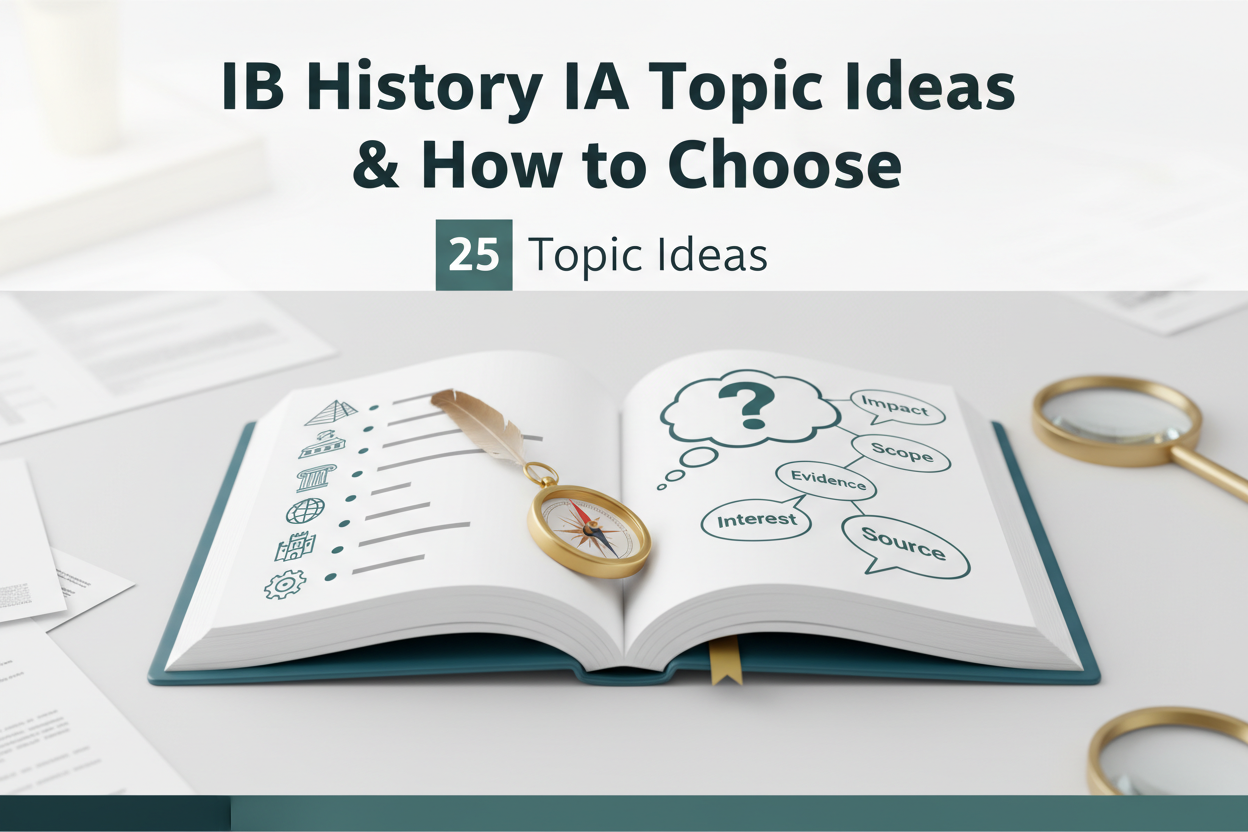
25 IB History IA Topic Ideas & How to Choose
Finding a great IB History IA topic is tough. Learn how to choose from 7 official topic types, use our 12-point checklist, and review 25 high-scoring IA examples.

How to Find a Good Research Question for IB History IA
Learn how to find a good research question for your IB History IA using expert tips, clear examples, and a breakdown of the official IB criteria for top marks.
.png)
The Ultimate Guide to Nailing Your IB Internal Assessment (IA)
A complete guide to the IB Internal Assessment. Learn how to choose a topic, manage your timeline, and structure your IA for a top grade. Includes tips for parents.

Complete Guide to IB Internal Assessments (IAs)
Understand IB Internal Assessments (IAs) and grading: learn how your teacher's guidance and the moderation process lead to your final, fair IB grade.

Science IB IA Analysis: How to Nail Uncertainty Calculations
Master your IB Science IA analysis by learning how to ace uncertainty calculations and data processing. Get expert tips to achieve top marks in Chemistry, Physics, and Biology.
Professional Support for the Final Push
GRADUATES
TEACHERS
EXAMINERS
BOOK A FREE CONSULTATION TODAY
Stockholm based, supporting students worldwide. We are IB experts committed to achieving your academic goals.
ABOUT US